Content options
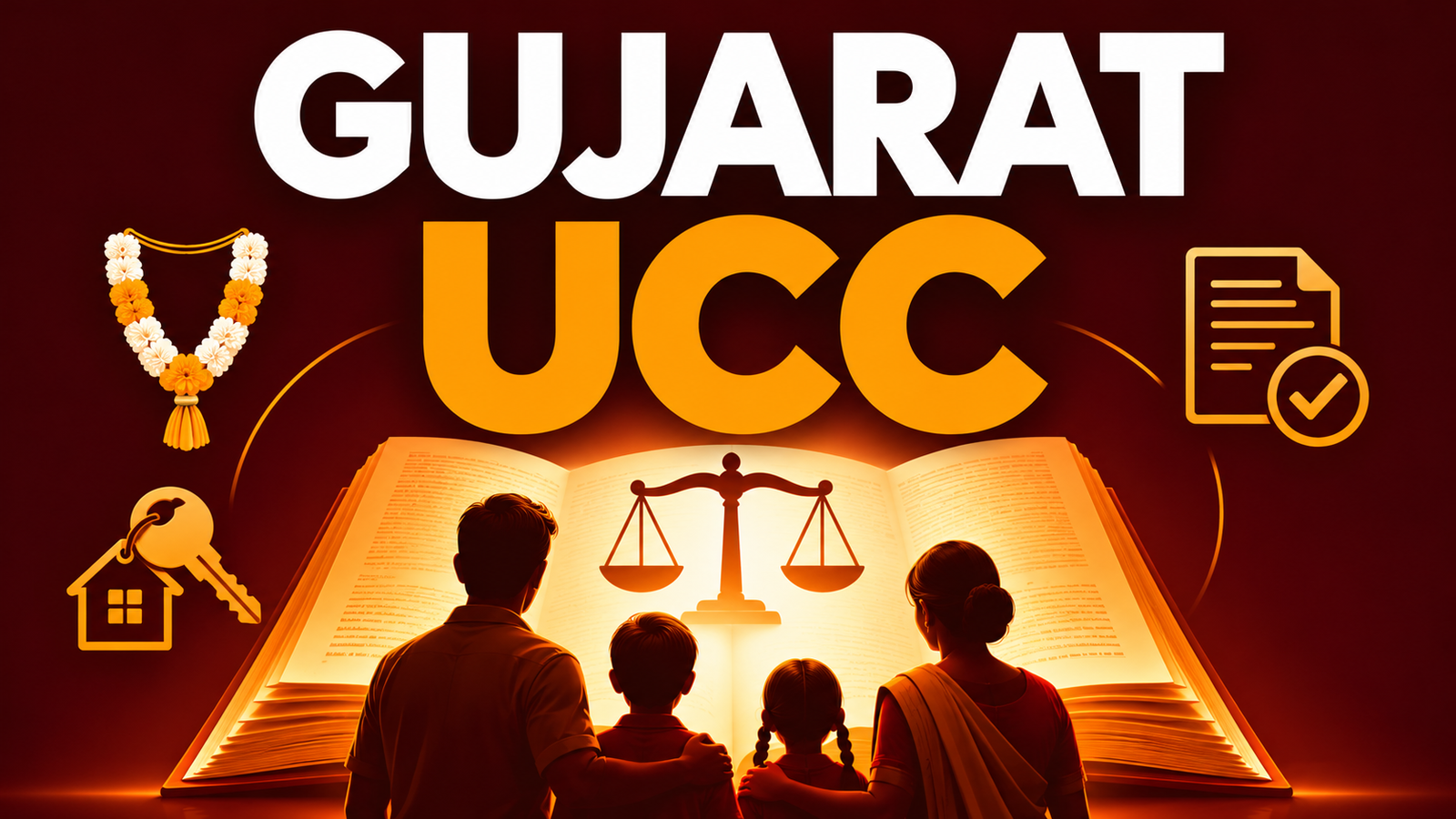
The Gujarat Uniform Civil Code, 2026 is a state law that aims to replace separate religion-based rules on family matters, such as marriage, divorce and inheritance, with one common set of rules for people it covers. Legal publications such as SCC Times have published explainers on the law. This guide covers how a Uniform Civil Code works, how it differs from the personal laws you know today, and what Gujarat families should check in the official text.
One caution first. Our source notes confirm only that the Gujarat law exists and has been explained by SCC Times. We have not reproduced section numbers, penalties or dates from the Act. Wherever a specific detail could change your decision, we say so and point you to the official text.
Key takeaways
- A Uniform Civil Code replaces religion-based family laws with one common law on subjects like marriage, divorce, adoption and succession.
- It does not touch worship, rituals or what a religious ceremony looks like. It deals with legal rights and procedures.
- Who is covered, and who is exempt, is decided by the text of the Gujarat Act. Read that, not forwarded messages.
- If you have a will, a pending property matter or a planned marriage, speak to a lawyer about how the new law applies to you.
What is a Uniform Civil Code in simple words?
India has one criminal law for everyone. A theft is a theft whatever your religion. Family law has been different. Marriage, divorce, adoption, maintenance and inheritance have mostly been governed by religion-specific rules, which are called personal laws.
A Uniform Civil Code is a proposal to have one law on these subjects for all citizens, regardless of faith. Article 44 of the Constitution says the State should endeavour to secure a uniform civil code for citizens across India. It sits in the Directive Principles, which guide the government but cannot be enforced in court like Fundamental Rights.
Why is a state like Gujarat passing its own code?
Family law falls in the Concurrent List, so both Parliament and state legislatures can make laws on it. That is the legal route states use to pass their own codes. Goa has long followed a common family law inherited from the Portuguese era. Uttarakhand passed its own UCC in 2024, and it was brought into force in January 2025. Reports suggest Gujarat's law follows a similar state-level approach, though the exact similarities and differences should be checked against the Gujarat Act.
A state law applies only inside that state. It cannot change how personal law works in Maharashtra or Rajasthan, and a national UCC would need Parliament.
How is it different from existing personal laws?
Today, which law applies to you depends largely on your religion. For Hindus, Buddhists, Jains and Sikhs, the main laws are the Hindu Marriage Act, 1955 and the Hindu Succession Act, 1956. Muslims are governed in many matters by the Muslim Personal Law (Shariat) Application Act, 1937. Christians and Parsis have their own marriage and divorce statutes. The Special Marriage Act, 1954 offers a civil route for any couple, including interfaith couples.
The table below shows the broad contrast. It describes the general idea of a UCC, not the exact clauses of the Gujarat Act.
| Area | Under existing personal laws | Under a UCC (general idea) |
|---|---|---|
| Marriage | Conditions and procedures differ by religion | One set of legal conditions, such as minimum age and consent |
| Divorce | Different grounds and processes by community | Common grounds and procedure |
| Inheritance | Shares and rules vary by religion and by whether there is a will | One succession framework |
| Adoption | Hindu law has detailed adoption rules, while other communities often rely on general guardianship law or the Juvenile Justice Act | Common adoption rules |
| Religious ceremonies | Each community follows its own | Generally left untouched |
Who does the Gujarat Uniform Civil Code cover?
In principle, a state UCC covers residents of that state. Beyond that, the coverage depends on the Act's wording, and you should check three points.
- Residency: whether the law applies to people domiciled in Gujarat, to people marrying within Gujarat, or both.
- Exemptions: Uttarakhand's code exempted Scheduled Tribes. Gujarat has a large tribal population, so see whether the Gujarat Act has any similar carve-out.
- Existing marriages and wills: whether the law applies to marriages already performed and to wills made before it came into force.
Do not assume the answers. A line in a forwarded message is not a substitute for the Act's text.
What might change for an ordinary Gujarati family?
Think of the practical moments when family law matters: a wedding, a separation, a death in the family, or an adoption. Under a UCC, the paperwork and legal rights at those moments would follow one law. Some states with a UCC have also added registration requirements, for example mandatory marriage registration in Uttarakhand. If Gujarat does the same, keep your marriage certificate and identity documents in order.
Property planning is the area where families most often feel the effect. If your family has land or a house, check how the new rules treat daughters, widows and children from different marriages. A registered will is the clearest way to record your wishes. Whether and how a will interacts with the Gujarat Act is a question for a lawyer, not a blog.
What a UCC does not do
It does not ban any religion, change how you pray or dictate wedding rituals. A couple can still hold a pheras ceremony, a nikah or a church wedding. The law concerns whether the marriage is legally valid and what rights follow from it.
Myth vs fact
- Myth: The UCC will abolish religious marriage ceremonies. Fact: UCC laws regulate legal rights and procedures. Ceremonies are generally left to each community, though you should confirm this in the text.
- Myth: It applies across India from now. Fact: A state law applies in that state only.
- Myth: Everyone in Gujarat is covered in exactly the same way. Fact: Exemptions and transition rules can exist, so the Act's wording decides.
- Myth: Court challenges will end the matter quickly. Fact: Constitutional questions about state UCCs can take time, so a legal position may stay unsettled for a while.
Checklist: what to do now
- Get the official Gujarat Act text from the state government or gazette, not from social media.
- Find the definitions and application section to see who is covered and who is exempt.
- Check the commencement date and any rules on existing marriages and wills.
- Look for registration requirements and deadlines for marriage or other events.
- Review your will, nominations and property papers, and consult a lawyer if anything is unclear.
Common mistakes to avoid
The biggest one is reacting to a summary rather than the Act. Short news items rarely cover exemptions, transition rules or penalties. Another mistake is assuming your old will or family arrangement is automatically void, or automatically safe. Neither is certain until you read the law and, if needed, take advice.
Families also confuse the Gujarat UCC with other new state laws. Tenancy, for instance, is a separate matter, and our guide to the Gujarat Rent Bill 2026 covers that. For the Constitution's wording on Article 44, you can use the national portal at india.gov.in.
Frequently asked questions
Is the Gujarat Uniform Civil Code the same as a national UCC?
No. It is a state law and applies in Gujarat only. A national UCC would need to be passed by Parliament and would apply across the country.
Does the Gujarat UCC change my religion's wedding rituals?
UCC laws generally concern legal validity, rights and procedures rather than ceremonies. Check the Act's text for any registration or procedural requirement that you must complete alongside your ceremony.
Will my existing marriage or will become invalid?
We cannot say without the Act's transition provisions. Whether the law applies to marriages and wills made earlier depends on its wording. A lawyer can read those provisions against your documents.
Are tribal communities in Gujarat covered?
Uttarakhand's code exempts Scheduled Tribes. Whether Gujarat's Act does the same, and to what extent, is something to confirm in the official text.
Where can I read the law itself?
Look for the Act on the Gujarat government's official legislative portal or in the Gujarat Government Gazette. Legal commentary, such as the SCC Times explainer, can help you understand it, but the Act is the authority.
Bottom line
The Gujarat Uniform Civil Code, 2026 is best understood as a move to put family law under one common rulebook for those it covers. For most families, the practical effect will show up in paperwork, inheritance and divorce rules, not in daily religious life. Your next step is to read the official Act, note the sections on coverage and transition, and ask a lawyer about your own will, property and marriage documents before making any change.