Content options
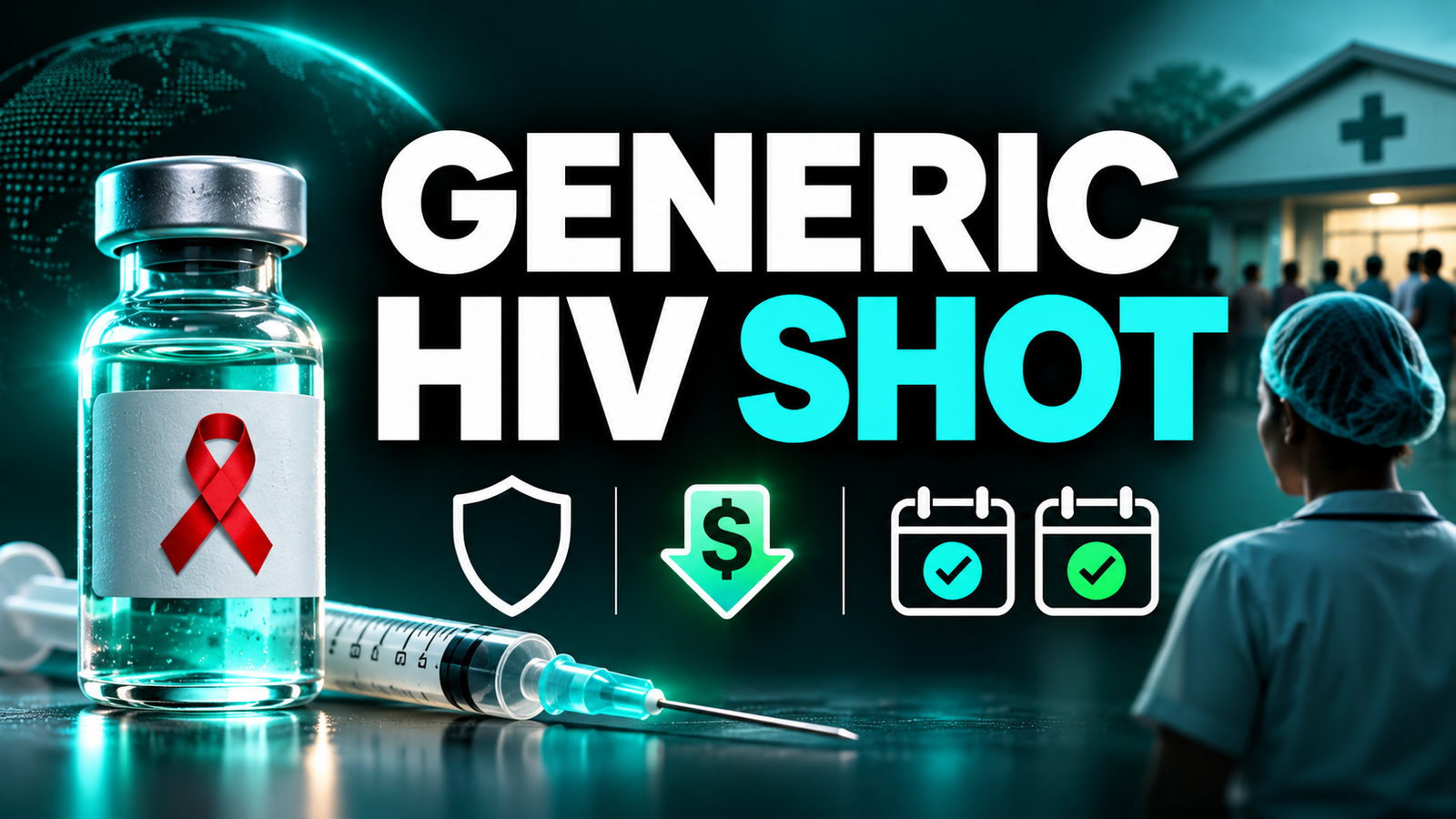
A low-cost generic version of a breakthrough HIV prevention injection has been approved in the United States, according to reports from Medical Xpress and France 24. The shot is lenacapavir, a long-acting form of PrEP (pre-exposure prophylaxis) that is given twice a year to people who do not have HIV. It prevents infection; it does not cure HIV or treat someone who already has it.
The approval is aimed at poorer countries, where the branded version has been far too expensive for public health programmes. The reports we have seen do not say when a person in India or any other country could actually get the generic, so this guide focuses on what the shot is, why price matters, and what to ask next.
Key takeaways
- The shot is PrEP: it is for HIV-negative people at risk of infection, given about every six months.
- PrEP is different from HIV treatment (ART), which is for people already living with HIV.
- A generic matters because price, not science, has been the main barrier in lower-income countries.
- US approval does not automatically mean sale in India. Each country's regulator and health programme decides.
What is the HIV prevention shot?
Lenacapavir is an antiviral drug that interferes with the protein shell (capsid) of the HIV virus. For prevention, it is injected under the skin, and one dose is designed to protect for roughly six months. The branded product, made by Gilead, was approved in the US in June 2025 under the name Yeztugo.
Before this, the main options were a daily PrEP tablet and an injection given every two months. Daily pills work very well when taken every day, but many people struggle with that over months and years, especially young women, people facing stigma, or anyone who cannot store pills privately. Two injections a year remove most of that daily burden.
In large trials, results were strong. Reports on the PURPOSE 1 trial in young women in Africa described no HIV infections among about 2,000 women who received the shot. Treat such figures as trial results under close supervision, not a guarantee for every person in every setting.
How is PrEP different from HIV treatment?
This is the point readers most often mix up. PrEP and treatment use similar families of drugs, but they have different purposes, different users and different testing rules.
| Feature | PrEP (prevention) | PEP (emergency) | ART (treatment) |
|---|---|---|---|
| Who it is for | HIV-negative people at ongoing risk | HIV-negative people after a single possible exposure | People who have HIV |
| When it is taken | Before and during risk | Within 72 hours of exposure, for about 28 days | Lifelong, continuously |
| Goal | Stop infection | Stop infection after exposure | Keep the virus suppressed and the person healthy |
| Example | Daily tablet or twice-yearly shot | A short course of combination tablets | Daily combination tablets |
One related detail causes confusion. A different lenacapavir product, used with other drugs, exists for treating people with HIV that resists many medicines. That is a separate use with separate dosing. The prevention shot is not meant for someone who already has HIV.
What do we actually know about the generic approval?
Two outlets, Medical Xpress and France 24, reported that US regulators approved a cheaper generic version of the shot for use in poorer countries, with the France 24 report attributing the news to the manufacturer. That is the confirmed core.
What the short reports we reviewed do not tell us is just as useful to know:
- Which exact generic company's product was approved, and in what strengths.
- Whether this is a full US market approval or a pathway designed mainly for supply abroad.
- The final price per person, and the date supply begins.
- Which countries will get it first.
Earlier, Gilead announced licences allowing several generic makers, including Indian companies, to produce the drug for 120 lower-income countries. Health groups including the Gates Foundation and Clinton Health Access Initiative said a generic could cost around US$40 per person per year from 2027. Treat these as announced plans, and check the latest figures before quoting them.
Why does a low-cost generic matter so much?
A medicine that works but costs too much protects only the people who can pay. The branded US list price was reported at about US$28,000 a year. No public programme in a low-income country can buy that at scale.
A worked example of the price gap
Take the reported figures and do the arithmetic. The shot is given twice a year.
- Branded US price: about $28,000 a year, so about $14,000 per injection.
- Announced generic target: about $40 a year, so about $20 per injection.
- Gap: 28,000 ÷ 40 = 700. The brand would cost about 700 times more per year.
At roughly ₹85 to the dollar, $40 is about ₹3,400 a year. A programme with a budget of $4 million could in theory cover 100,000 people for a year at the generic price ($4,000,000 ÷ $40), but only about 140 people at the branded price ($4,000,000 ÷ $28,000). Real costs also include testing, clinic visits and delivery, so the true figure per person will be higher than the drug price alone.
This is the same pattern we see when generics arrive for other expensive drugs, as in our explainer on GLP-1 drug prices, generics and insurance in India. The molecule stays the same; competition and licensing change who can afford it.
Who can get an HIV prevention shot?
Eligibility is set by each country's guidelines, not by the drug alone. In general, PrEP is offered to HIV-negative people with ongoing risk, for example someone whose partner has HIV that is not yet suppressed, people who have sex without condoms with partners of unknown status, people with recent sexually transmitted infections, and people who inject drugs with shared equipment.
The World Health Organization has issued guidance on lenacapavir for prevention, recommended in July 2025 as an additional option. You can read general WHO material on HIV at who.int. Early supply in poorer countries is likely to focus on groups with the highest risk, because doses will be limited at first.
What the shot does not do
- It does not protect against other infections such as syphilis, gonorrhoea or hepatitis B.
- It does not prevent pregnancy.
- It does not treat HIV, and starting it without an HIV test can be harmful if the person already has the virus.
Because the drug stays in the body for months, missing a follow-up injection leaves a stretch of lower drug levels. Regular testing and on-time visits are part of the plan, not an optional extra.
Will it reach people in India?
The honest answer is that nobody can say yet. India has strong generic manufacturers, and Indian firms are among those reported to hold licences, but production capacity is different from availability in clinics. Before a product is sold or used in India, it needs approval from the Indian drug regulator (CDSCO) and a decision on how it fits into national HIV programmes.
If you are in India and want to know about PrEP today, ask at a government ICTC (counselling and testing centre) or a qualified doctor about what is currently available. Do not buy injections from unverified sellers online. A fake or wrongly stored product gives false protection, which is worse than none.
Common myths about the HIV prevention shot
- Myth: It is a vaccine. Fact: It is a drug that stays in the body for months. It does not train the immune system.
- Myth: A generic is a weaker copy. Fact: Generics must show they deliver the same active drug in the same way as the original, which is what regulatory approval checks.
- Myth: If you take PrEP, you do not need testing. Fact: Regular HIV tests are part of safe use.
- Myth: It is a cure. Fact: There is no cure for HIV. For another health condition where the word "cure" is used carefully, see our piece on hepatitis B functional cure.
A short checklist before you talk to a clinic
- Write down your reason for asking: partner status, past exposure, or a general wish for protection.
- Ask for an HIV test first, and a check for other infections.
- Ask which PrEP options the clinic actually offers: tablets, two-monthly injection, or the six-monthly shot.
- Ask what follow-up schedule applies and what happens if you miss a visit.
- Ask about cost, including testing and consultation, not only the drug.
When reading any trial claim along the way, remember that numbers come from specific groups and conditions. Our explainer on what a 68% remission trial shows walks through how to read such headlines sensibly.
FAQ
What is the HIV prevention shot called?
The drug is lenacapavir. The branded prevention version in the US is Yeztugo. The newly reported generic is a lower-cost version of the same medicine.
How often is the shot given?
About once every six months, after an HIV test confirms the person is negative. A health worker gives it as an injection under the skin.
Is the generic as safe as the original?
Regulators approve generics only after checking they contain the same active drug and perform equivalently. Side effects reported with the branded shot include reactions at the injection site, such as lumps or soreness, which a doctor can explain in detail.
How much will the generic HIV prevention injection cost?
It is not final. Health groups announced a target of about US$40 per person per year in lower-income countries, but actual prices will depend on the buyer, the country and the date supply starts.
Can I get this HIV prevention shot in India now?
The reports we reviewed do not say it is available in India. Ask a government testing centre or doctor about the PrEP options currently offered, and avoid unofficial online sellers.
Bottom line
A cheap generic could turn a very effective prevention tool from a rich-country product into something health systems elsewhere can afford. The approval is a real step, but the main questions of supply date, price and national rollout are still open. If prevention matters to you now, the next step is simple: get an HIV test and ask a qualified clinician what PrEP options are available where you live.