Content options
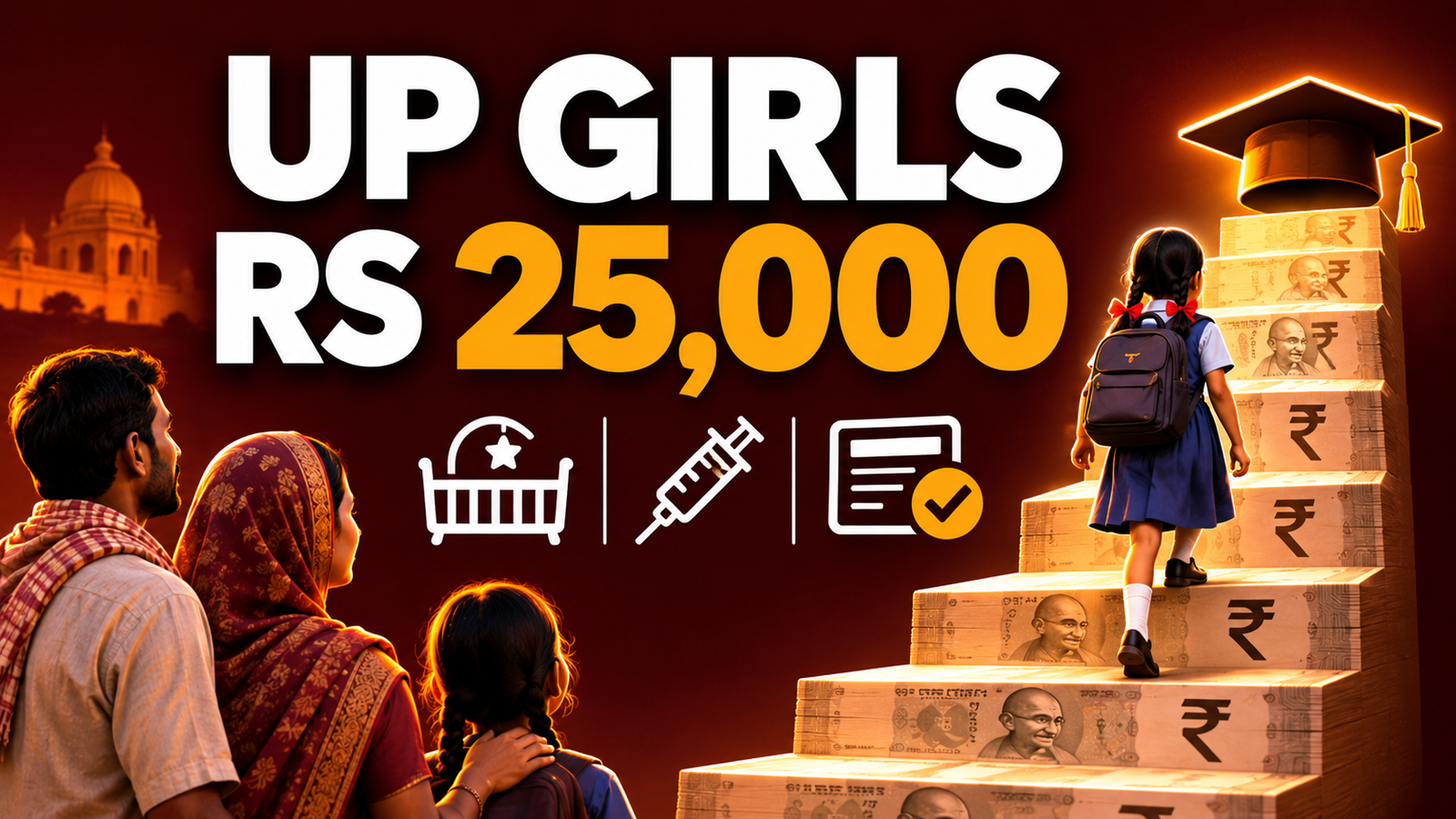
The UP Rs 25,000 scheme for girls is the Uttar Pradesh government's Kanya Sumangala Yojana. According to reports, including India Today, it pays up to Rs 25,000 into a girl's family account in instalments, starting at birth and ending when she reaches graduation. You do not get the money in one go: each payment is tied to a milestone such as immunisation, school admission or passing an exam.
For most eligible families the practical task is simple. Register early, keep the proof for each stage, and apply again at every milestone without letting deadlines slip.
Key takeaways
- The scheme is for girls from Uttar Pradesh families who meet an income limit, reported at Rs 3 lakh a year.
- Payment is milestone-based, from birth through immunisation, school classes and graduation, and not a lump sum.
- Keep a birth certificate, Aadhaar, income certificate, residence proof and bank details ready from day one.
- Amounts and rules have been revised before, so check the latest government order before you apply.
What is the UP Kanya Sumangala Yojana?
It is a state scheme meant to improve how families in Uttar Pradesh treat the birth, health and education of daughters. The state launched it with a smaller total and later raised the benefit. The headline figure reported now is Rs 25,000 per eligible girl.
The design is the important part. Because money arrives at milestones, it nudges families towards vaccination, enrolment in school and keeping the girl in education. It is a conditional cash transfer, not a pension or a savings account in the girl's name.
Who is eligible? A checklist
Reports and earlier government notices list conditions along these lines. Tick each one before you spend time on forms.
- Residence: the family should be a permanent resident of Uttar Pradesh.
- Income: total family income from all sources under the limit, reported at Rs 3 lakh per year.
- Number of children: the benefit has been limited to up to two daughters per family, with special treatment for twins or multiple births.
- Birth date: the girl should be born on or after the cut-off date in the order, historically 1 April 2019 for the revised version.
- Adoption: an adopted daughter has been covered under certain conditions, and the notice will say which.
- Bank account: an account that is active and linked to Aadhaar, so direct benefit transfer can reach it.
If your family sits close to the income limit, do not guess. A tehsil income certificate decides this, not your own estimate.
Which documents do you need?
The same papers get asked for at several stages, so make a single folder, paper and phone copy.
- Girl's birth certificate (and the parents' Aadhaar cards)
- Income certificate issued by the competent authority, usually the tehsil
- Domicile or residence proof for Uttar Pradesh
- Bank passbook or cancelled cheque, with the account holder's name clearly visible
- Immunisation card, for the first-year stage
- School admission proof or bonafide certificate, for the class-wise stages
- Marksheet or pass certificate, and later a degree or college admission proof
- Passport-size photographs and a mobile number linked to Aadhaar
Names must match across all documents. A girl's name spelt two ways on the birth certificate and the school record is among the most common reasons for delay.
How does the milestone-wise payment work?
The scheme pays in stages. The milestones below are those generally reported, shown with the calendar year for a girl born in 2026 so you can plan. Reports differ on how the Rs 25,000 is split between stages, so we have not printed a rupee figure per row. Read the exact amounts off the current official order.
| Stage | Typical timing (girl born 2026) | Proof to keep |
|---|---|---|
| Birth | 2026 | Birth certificate, bank account |
| Full immunisation in first year | Around 2027 | Immunisation card |
| Admission to class 1 | Around 2032 | School admission record |
| Admission to class 6 | Around 2037-38 | School record or bonafide |
| Admission to class 9 | Around 2040-41 | School record |
| Senior school stage (class 10/12) | Around 2042-44 | Marksheet or admission proof |
| Graduation stage | Around 2047-48 | Degree or college proof |
The exact class that triggers each payment, and whether it needs admission or a pass certificate, has changed between versions of the scheme. Treat the table as a planning aid and not the rule.
What does Rs 25,000 actually mean for a family?
A quick calculation puts the benefit in perspective. Suppose a girl is born in 2026 and the last payment arrives around 2048. That is roughly 21 to 22 years.
Rs 25,000 divided by 21 years is about Rs 1,190 a year, or around Rs 99 a month. It will not pay for an education. It does give a small, predictable top-up at the points where families often hesitate: school fees, books, a uniform, a college form.
Now a worked eligibility check. A family in Lucknow earns Rs 15,000 a month from a small shop, plus Rs 5,000 a month from rent. That is Rs 20,000 a month, or Rs 2,40,000 a year. Against a reported limit of Rs 3 lakh, they fall within it by Rs 60,000. If the rent rose to Rs 12,000 a month, the annual total would be (15,000 + 12,000) x 12 = Rs 3,24,000, which is over the limit. Income from every source counts, so add it all up before you apply.
How to apply for the UP scheme for girls
The process has run through an online portal and through local offices. The steps below follow the usual sequence. Confirm the portal address and office names from the official notice, because we have not linked a deep page we cannot verify.
- Get the papers. Apply for the income certificate and domicile proof first, since they take the longest.
- Register the girl. Use the state's official application route, the Kanya Sumangala portal, or the district office handling women and child welfare, and fill in the family details.
- Upload or submit documents. Scan clearly. Blurred photos of certificates are a common reason for rejection.
- Note the application number. Screenshot or write it down. You will need it for follow-up.
- Apply again at each milestone. Each stage has its own claim, supported by the relevant proof.
- Track the payment. Money is expected through direct bank transfer, so check the passbook and call the district office if a claim stalls.
If you are not comfortable with online forms, a Common Service Centre or the local Anganwadi worker can usually point you to the right office. Never pay an agent for a free government scheme.
Common mistakes that delay payments
- Bank account not linked to Aadhaar or closed after a long period of inactivity
- Income certificate that has expired or was issued for a different purpose
- Name or date of birth mismatches between documents
- Missing a claim window at school admission and then having to explain it
- Applying for a third daughter without checking the family-size rule
Myth versus fact
Myth: The family receives Rs 25,000 as soon as a girl is born.
Fact: The total is spread over many stages across about two decades, and each one depends on a milestone.
Myth: Any girl in India can claim it.
Fact: It is a state scheme meant for eligible Uttar Pradesh families, with income and residence conditions.
Where this fits among government schemes
Girls' benefit schemes tend to follow the same pattern: income-linked eligibility, proof-heavy paperwork and staged payouts. If you are tracking other state or central programmes, our guide to the Agniveer scheme changes shows the same habit of checking official notices before you act, and our explainer on the Samudra Manthan scheme shows how to read headline figures in a scheme announcement. For general household planning around a daughter's future, a simple budget plan for gold and silver purchases can help you separate small yearly savings from big goals. You can also browse official scheme information on india.gov.in.
FAQ
Is the UP Rs 25,000 scheme for girls the same as Kanya Sumangala Yojana?
Yes. Reports describe the Rs 25,000 benefit as part of the Kanya Sumangala Yojana run by the Uttar Pradesh government. The amount and conditions have been revised over time, so use the latest order.
Can I apply if my daughter was born before the scheme started?
It depends on the cut-off date in the current order. Girls born before that date may not qualify for the early stages, though some later stages could still apply. Ask the district office with your birth certificate in hand.
Who receives the money, the girl or the parents?
It is paid through direct benefit transfer into a bank account that was registered during the application. The notice will say whether it should be the mother's, a guardian's or the girl's account once she is old enough.
Can a family with three daughters claim for all of them?
The scheme has capped the benefit at a set number of daughters per family, historically two, with provisions for twins. Check the present rule before you apply, since it has been interpreted differently across notices.
What if my application is rejected?
Ask the office for the reason in writing. Most rejections come from document mismatches or income proof. Correct the error and re-apply, or approach the district officer if you think the decision was wrong.
Bottom line
The scheme is worth the paperwork for eligible families, mainly because the payments land at points when school costs rise. Start with the income certificate and a working Aadhaar-linked bank account, then register the girl as early as the rules allow. Before you pay anything or submit forms, read the latest government order or ask your district women and child welfare office, as amounts, cut-off dates and procedures can change.