Content options
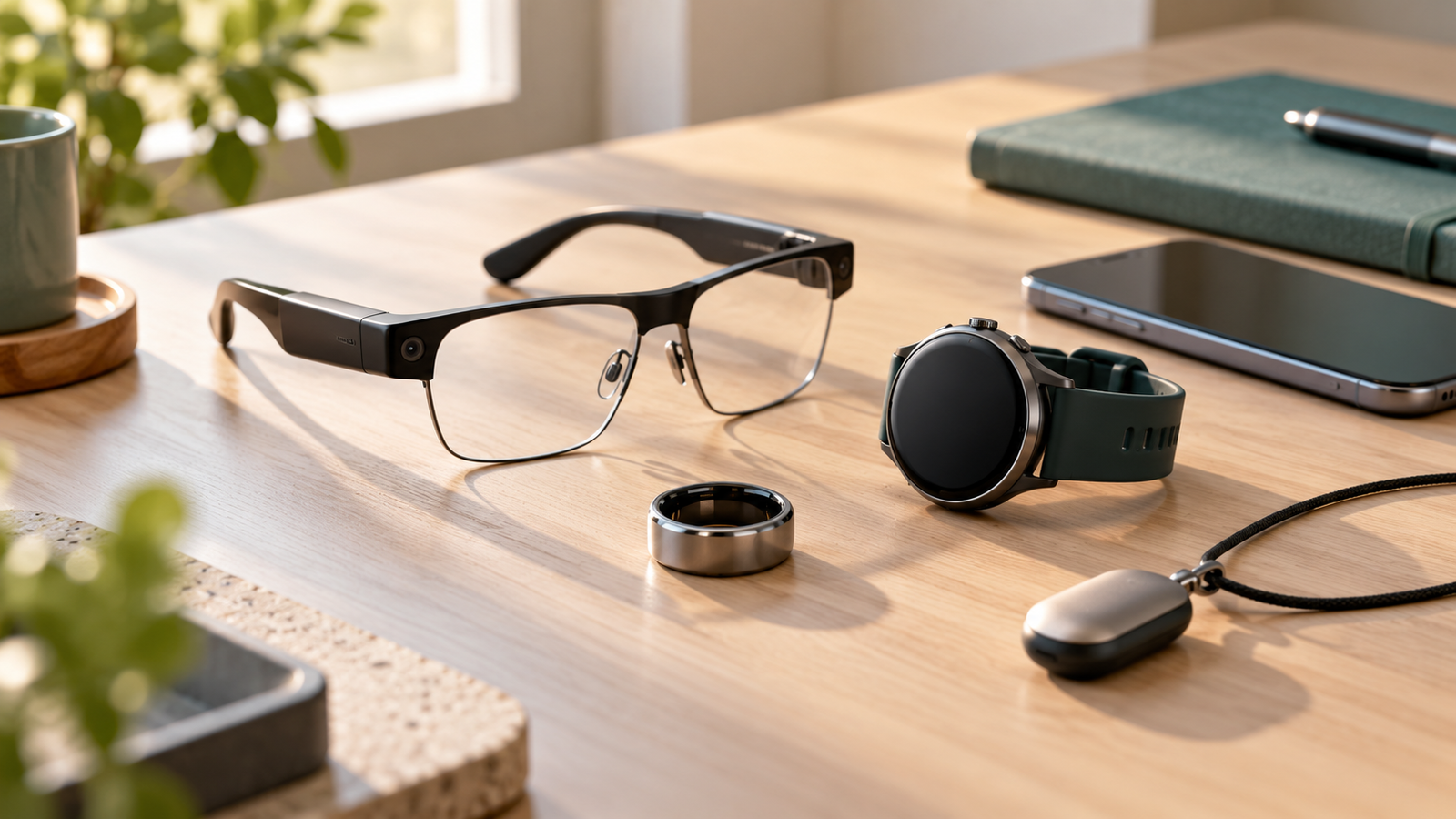
For most people, the best AI wearable in 2026 is still a smartwatch or smart ring from a brand with a long track record. Smart glasses are the most interesting newer category, and AI pendants and pins are the riskiest buy. Which one is right depends on what you want the device to do all day, and how comfortable you are with a microphone or camera on your body.
Tech outlets such as TechCrunch have been running roundups of the hottest AI wearables and gadgets. We have not reproduced that list here. Instead, this guide sorts the whole field into categories, so it stays useful even as individual models change. Prices, battery claims and features move quickly, so anything specific below is flagged for checking against the maker's current page.
Key takeaways
- Smartwatches and rings are the safest buys: they track health well and add AI features as extras.
- Smart glasses suit people who want hands-free photos, calls and voice questions, but battery life is short.
- Always-listening pendants and pins carry the biggest privacy trade-off and often a monthly fee.
- Count subscription costs and import charges before you decide, not just the sticker price.
What counts as an AI wearable?
An AI wearable is any device you wear that uses a microphone, camera or body sensors, then runs the data through an AI model to give you something useful. That could be a spoken answer, a meeting summary, a sleep score or a translated sentence.
Most of the heavy lifting does not happen on the device. Typically the wearable captures audio, images or sensor readings, sends them to your phone, and your phone passes them to a cloud service. That matters for battery, for privacy and for what happens when your internet drops.
How do the main types compare?
The table below gives typical ranges rather than exact specs. Treat every number as a starting point and confirm it with the manufacturer before buying.
| Type | What it actually does | Typical price | Typical battery | Main privacy concern |
|---|---|---|---|---|
| Smart glasses | Camera, open-ear audio, voice assistant, calls, some live translation | roughly $300 to $400 | a few hours of active use, longer on standby | Camera can capture people nearby who do not know |
| Smart ring | Sleep, heart rate, activity and readiness scores, AI-written insights | roughly $250 to $450, often plus a membership | about 4 to 7 days | Health data stored on company servers |
| Smartwatch | Health tracking, notifications, payments, voice assistant, fitness coaching | roughly $150 to $800 depending on brand | 1 to 2 days on mainstream models, longer on sports watches | Health and location data |
| AI pendant or clip | Records conversations, transcribes and summarises them, sometimes acts as a companion | roughly $50 to $200, often with a subscription | 1 day to several days, varies widely | Records other people's speech, often continuously |
| AI pin or screenless gadget | Voice assistant, camera, projected display on some models | Varies | Short, often needs spare batteries | Always-on mic and camera |
AI glasses vs smartwatch: which should you pick?
A smartwatch wins if you care about health, fitness, payments and notifications. It has years of refinement behind it, and the AI additions, such as workout suggestions or voice replies, sit on top of features that already work.
Smart glasses win if your phone is usually in your pocket and you want to ask a question, take a photo or answer a call without reaching for it. Walking, cycling and cooking are the obvious cases. The catch is that glasses are a fashion item, so frame style, prescription lenses and comfort matter as much as the AI.
If you can only afford one, a watch is the lower-risk choice. If you already own a good watch, glasses add something new, while a second watch adds nothing.
Are AI pendants and smart rings worth it?
Smart rings are worth it for one specific person: someone who wants sleep and recovery data without wearing a watch to bed. The ring is comfortable and the battery lasts days. But check whether the useful insights sit behind a monthly or yearly membership, because that changes the real price.
AI pendants are harder to recommend. The promise is attractive: record your day, get searchable notes and action items. In practice, the value depends on whether you hold enough meetings or conversations that you genuinely need to recall. A student or consultant might. Someone who wants a general gadget probably will not.
The category is also volatile. Several early AI gadgets have been discontinued or sold off by their makers, which leaves buyers with hardware that loses features. Before you buy any new-brand device, check how long the company has been selling and what the support policy says.
Do AI wearables record everything?
It depends on the device, and the answer is often not obvious from the packaging.
- Glasses usually capture photos or video only when you trigger them, and most show a light while recording. They may still listen for a wake word.
- Pendants and clips that transcribe conversations are designed to record for long stretches, because that is the product.
- Rings and watches do not record audio by default, but they collect continuous body data such as heart rate, temperature and movement.
Recorded audio and images are commonly processed in the cloud, so check whether the company stores them, for how long, and whether you can delete them. Also check whether your data may be used to train AI models, and whether that is switched on by default.
There is a social side too. Recording another person's conversation without their consent can be a legal problem in some places, and the rules differ by country and state. At the very least, it is bad manners. If you plan to use a recording device for work meetings or client calls, get consent and speak to a lawyer if the stakes are high.
What will it really cost? A worked example
Sticker prices hide the true cost. Here is a hypothetical AI pendant to show the arithmetic. These numbers are illustrative, not a real product quote.
- Device price: ₹15,000
- Subscription: ₹800 per month for 24 months = 800 × 24 = ₹19,200
- Total over two years: 15,000 + 19,200 = ₹34,200
- Cost per day: 34,200 ÷ 730 days = about ₹47 per day
The subscription costs more than the gadget. Ask yourself whether the summaries save you ₹47 worth of time every day. If you attend two meetings a week, probably not. If you work in interviews or research, maybe.
For imported devices, add shipping, customs and GST where they apply, and remember that the cost of electronics can shift with trade policy. Our explainer on how new tariffs could make everyday products more expensive covers why.
A quick checklist before you buy
- Write down the one job you want it to do. If you cannot, wait.
- Find the monthly fee, if any, and multiply by 24.
- Check battery life in real use, not in the headline claim, using independent reviews.
- Read what the privacy policy says about audio, images and AI training.
- Confirm it works with your phone, since some devices favour one operating system.
- Check for Hindi, Gujarati or other Indian-language and accent support if you plan to use voice.
- Look at the return window and warranty, and whether service exists in India.
Common mistakes buyers make
The first is buying a category because it is in the news. Hype cycles often run ahead of what the product does, and early devices tend to get cheaper or better a year later.
The second is ignoring subscription costs. The third is assuming a device works well in India because it works well in the US. Many launch there first, and features such as local payments, maps, language support and customer service may lag behind.
The fourth is forgetting that you are not the only person affected. If you wear a camera or recorder around colleagues, friends or family, they have a say in how comfortable that is.
Myth vs fact
Myth: AI wearables will replace your phone. Fact: Nearly all of them depend on a phone for connectivity, setup and processing. Some people are going the other way and simplifying their devices, as we explain in our piece on why millions are switching back to feature phones.
Myth: More AI means better health tracking. Fact: Accuracy comes from the sensors and the algorithms behind them. A chatbot summary of your sleep does not make the measurement more reliable.
Myth: If a gadget is made by a big company, your data is safe. Fact: Size does not guarantee good privacy. Read the settings, and protect your accounts with strong sign-ins, ideally passkeys. Our comparison of passwords vs passkeys explains the difference.
India note: what to check locally
If you are buying in India, check whether the product is sold officially here, because grey-market imports can leave you without warranty. Look at whether subscriptions can be paid in rupees or only by international card, which may add currency conversion charges.
Also think about use cases that fit Indian conditions: noisy streets for voice assistants, battery life during long commutes, and heat and sweat for rings and watches. A device that works well in a quiet US office may feel different on a Gujarat summer day.
If you want to try AI without buying hardware, there is a cheaper route. Our list of free AI websites lets you test summaries, transcription and writing help on the phone you already own.
Which one fits you?
- You want health and fitness data: a smartwatch, or a ring if you dislike wearing a watch to sleep.
- You want hands-free photos, calls and voice help: smart glasses, ideally tried on in a shop first.
- You hold many meetings or interviews: consider a recording pendant, but only after checking consent rules and subscription costs.
- You are curious but unsure: wait. Prices and quality are changing fast, and the AI industry itself is going through swings, as we covered in our look at the AI boom and chip stocks.
FAQ
Are AI wearables worth it in 2026?
They are worth it when they solve a clear daily problem, such as sleep tracking or hands-free calls. For general curiosity, most people will get more value from the phone and watch they already have.
Which is better, AI glasses or a smartwatch?
A smartwatch is better for health, fitness and payments. Glasses are better for hands-free camera and voice use. If you must choose one, the watch is the more proven option.
Do AI wearables record everything you say?
Not all of them. Pendants built to transcribe conversations often record for long periods, while glasses typically capture only when triggered. Read the privacy settings to see what is stored and for how long.
Do AI wearables need a subscription?
Many do, especially rings and pendants, where AI summaries or deeper insights may sit behind a monthly or yearly fee. Check the fee before buying and multiply it over two years to see the real cost.
Can I use AI wearables without a smartphone?
Usually not for the full experience. Most pair with a phone for setup, internet and processing, so plan on owning a compatible phone.
Bottom line
Buy for a specific job, not for the label. If you already wear a watch, you may need nothing new. If you want something fresh, try smart glasses in person, and read the privacy policy and fee structure before you pay. Prices, specs and availability change often, so confirm the current details with the manufacturer or an independent review before you buy.