Content options
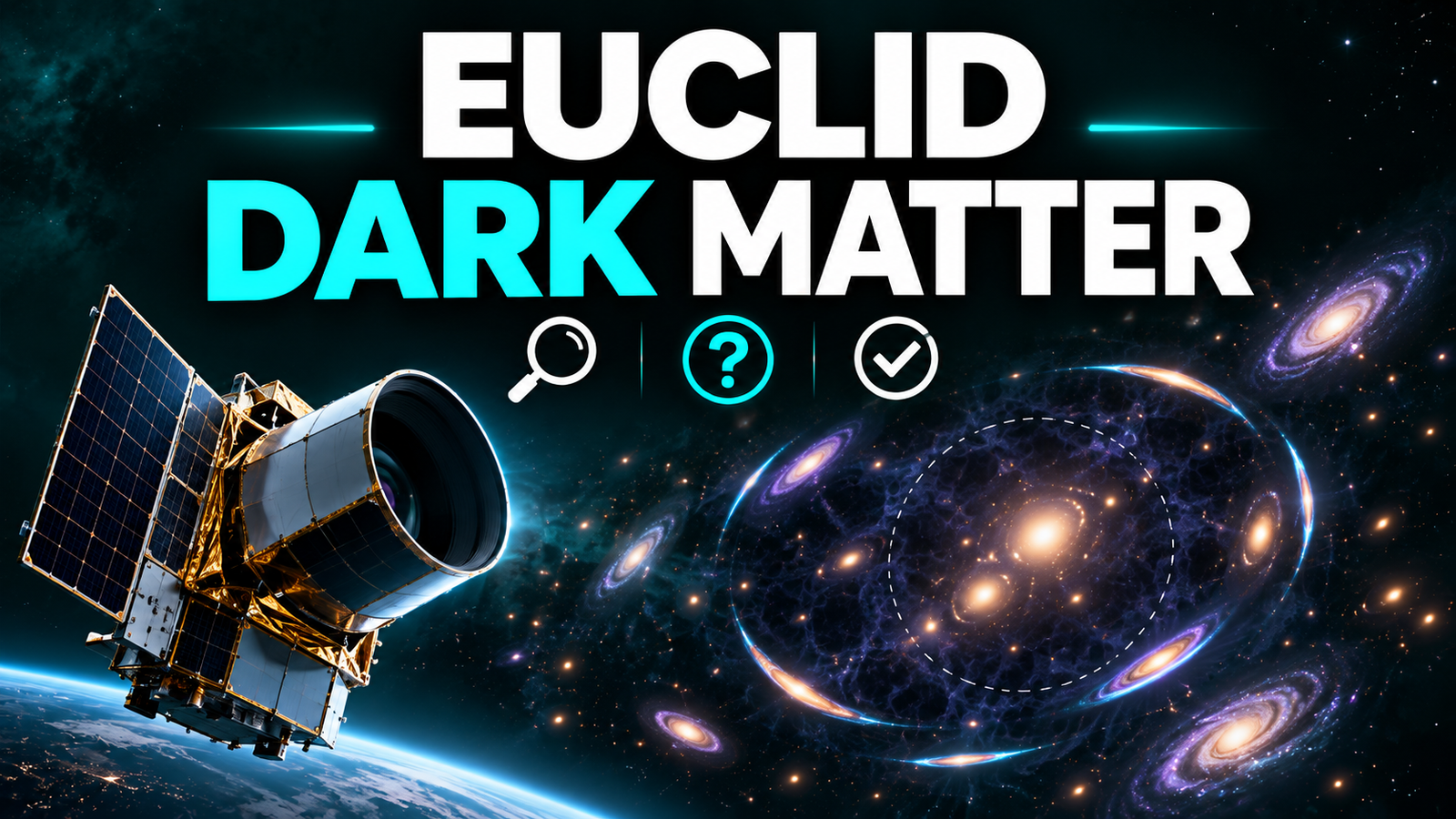
Euclid's first images do not reveal dark matter, and they were never meant to. They show that the European Space Agency's telescope works as designed, which matters because its real job is to map where invisible matter sits across billions of galaxies over several years. The dark matter answers, if they come, will come from that map, not from one pretty picture.
Key takeaways
- Euclid is an ESA space telescope built to measure how dark matter and dark energy shaped the universe, by studying the shapes and positions of huge numbers of galaxies.
- Dark matter cannot be photographed because it does not give off, absorb or reflect light. We detect it only through its gravity.
- The first images are a proof of performance. Headlines asking whether a "breakthrough" is coming are asking about the full survey, which takes years.
- Even the final map will describe how dark matter is spread out. It will not, by itself, say what dark matter is made of.
What is the Euclid space telescope?
Euclid is a mission of the European Space Agency (ESA), launched in July 2023 on a SpaceX Falcon 9 rocket. It sits near a point in space called the second Sun-Earth Lagrange point, or L2, roughly 1.5 million kilometres from Earth on the side away from the Sun. From there it has a steady, cold, dark view of the sky.
The telescope has a mirror about 1.2 metres across, much smaller than Hubble's 2.4 metres. What it has instead is a very wide field of view. Hubble is like a zoom lens that studies one small patch in great detail. Euclid is closer to a wide-angle lens that photographs enormous areas of sky sharply.
It carries two instruments. One takes sharp images in visible light, which is what lets scientists measure galaxy shapes precisely. The other works in near-infrared light and measures galaxy brightness and distance. Together they let the team build a three-dimensional map, not just a flat picture.
What is dark matter, in simple words?
Dark matter is the name for whatever is producing extra gravity in the universe that we cannot account for with the stars, gas and dust we can see. It is not "dark" like a black cloud. It is invisible, because it does not interact with light at all.
The evidence is old and strong. In the 1930s, astronomer Fritz Zwicky noticed that galaxies in the Coma cluster moved too fast to be held together by their visible mass. Decades later, Vera Rubin and colleagues found that stars at the edges of spinning galaxies orbit as fast as those near the centre, which only makes sense if there is a lot of unseen mass around them.
Current measurements suggest the universe is made of about 5% ordinary matter (everything we are made of), roughly 27% dark matter and about 68% dark energy.
Why is dark matter so hard to see?
Every telescope ever built works by catching light or some other radiation. Dark matter does not emit, absorb or reflect light, so there is nothing for a camera to catch. It passes through ordinary matter almost untouched, including through our bodies, constantly.
What dark matter does do is pull on things. That pull is the only handle we have. So the strategy is indirect: look at what visible things do, and work backwards to the unseen mass causing it.
Laboratory experiments buried deep underground have tried for years to catch a dark matter particle directly. As far as we know, none has succeeded. That is why mapping its gravity from space matters so much.
How does Euclid actually map something invisible?
Euclid relies mainly on two methods. The first is the more important one for dark matter.
Method 1: weak gravitational lensing
Gravity bends light. When light from a faraway galaxy passes a clump of mass on its way to us, its path is nudged and the galaxy's image is stretched very slightly. This holds whether the mass is visible or not.
- Euclid measures the shapes of billions of distant galaxies.
- On average, galaxies should point in random directions, like pencils scattered on a table.
- If many galaxies in one region are stretched in a matching pattern, something massive lies between them and us.
- Scientists convert that pattern into a map of where the total mass is, and subtract the visible matter to see what is left.
The distortion in any single galaxy is tiny and gets lost in the natural variety of galaxy shapes. It only emerges from statistics over huge numbers of galaxies, which is why Euclid needs such a big survey.
Method 2: how galaxies cluster over time
Galaxies are not scattered evenly. They form a cosmic web of clusters, filaments and empty voids, and its pattern depends on how dark matter pulled things together and how dark energy stretched space. By measuring distances to many galaxies at different cosmic times, Euclid can see how the web grew.
Because light takes time to travel, looking at more distant galaxies means looking further into the past. Euclid is designed to look back around 10 billion years, which covers the period when dark energy began to dominate.
Dark matter vs dark energy: how are they different?
The names sound similar and people mix them up. They are different problems that happen to share a telescope.
| Feature | Ordinary matter | Dark matter | Dark energy |
|---|---|---|---|
| Share of the universe (approx.) | About 5% | About 27% | About 68% |
| Interacts with light? | Yes | No | No known interaction |
| Main effect | Forms stars, planets, people | Extra gravity that holds galaxies and clusters together | Appears to speed up the expansion of the universe |
| How we detect it | Directly, with telescopes | Through its gravitational effects | Through the expansion history of the universe |
| Do we know what it is? | Yes | No | No |
What do Euclid's first images prove and not prove?
After launch, ESA released early test images and later a first set of full-colour pictures, according to reports and ESA's own announcements. They showed nearby and distant objects in sharp detail, including a famous galaxy cluster and a well-known nebula. Specific targets and dates are best checked on ESA's website.
What they show: the optics are sharp, the instruments are stable, and the telescope can capture wide fields without blurring. For a lensing survey that depends on measuring galaxy shapes to a tiny precision, this is the most important early test. It is real and meaningful progress.
What they do not show: a dark matter map, a new particle, or an answer to what dark energy is. A single image of a galaxy cluster is a beautiful photograph. Turning it into a mass measurement takes careful calibration and statistics across huge areas.
So the headline question, "Dark matter breakthrough coming?", has an honest answer: possibly, but not from the first look. The survey is planned to run for about six years and cover roughly a third of the sky, and the main cosmology results depend on that full dataset.
Myth vs fact
- Myth: Euclid will take a photo of dark matter. Fact: It will infer dark matter from how it bends light, and show the result as a map.
- Myth: The first images already solved the mystery. Fact: They confirmed the telescope's quality. The science comes from the full survey.
- Myth: Dark matter and dark energy are the same thing. Fact: Dark matter pulls, dark energy appears to push space apart. Both are unexplained.
- Myth: If we cannot see it, scientists are guessing. Fact: The evidence comes from several independent sources, including galaxy motions, lensing and the early-universe background radiation. What is unknown is its nature, not the fact that something is there.
What could Euclid's results change?
The most likely outcome is a sharper test of the standard model of cosmology. If the measured growth of structure matches predictions, that strengthens the current picture. If it does not match, it could hint that our theory of gravity or of dark energy needs adjusting.
Euclid will also help rule things out. Some proposed dark matter types would clump differently on small scales, and a precise map can favour some ideas and weaken others. That is how a lot of science actually moves: not with a single eureka, but by narrowing the field.
Be wary of anyone promising a definite answer on a date. Large surveys often find surprises in calibration and data processing before they find surprises in the universe.
Where can you follow it reliably?
Check ESA's mission pages for official image releases and data updates. Be cautious with social media posts that call any new image "proof" of dark matter. A real result will come with a paper, a described method and uncertainties.
If you enjoy this kind of story, our pieces on the year's top scientific breakthroughs, the real timeline for Mars missions and the NASA Artemis II Moon mission cover other space projects in the same plain style.
FAQ
What is the Euclid telescope looking for?
It is studying how dark matter and dark energy shaped the universe. It does this by measuring the shapes, brightness and distances of billions of galaxies, then looking for tiny distortions and clustering patterns that reveal unseen mass and the expansion of space.
Has Euclid found dark matter?
No. The first images show the telescope works well. Dark matter has not been directly detected by any instrument so far. Euclid will map where it is, which is different from identifying what it is.
Why can't normal telescopes see dark matter?
Normal telescopes collect light or other radiation. Dark matter neither emits nor absorbs light, so it leaves nothing for them to collect. Only its gravity gives it away.
How long will the Euclid survey take?
The plan is a survey of about six years covering roughly a third of the sky, with data released in stages. Timelines can shift, so check ESA for current schedules.
Is Euclid bigger than the James Webb Space Telescope?
No, its mirror is smaller than Webb's. They do different jobs. Webb zooms in on small areas in infrared detail, while Euclid surveys vast areas to build statistics about the whole cosmic web.
Bottom line
Euclid's first look is a good sign, not a verdict. The real test of its dark matter work will be a published map built from years of data, with clear uncertainties. Next step: when the next data release comes, read ESA's own summary first, and treat any headline using the word "breakthrough" as a prompt to look for the paper behind it.