Content options
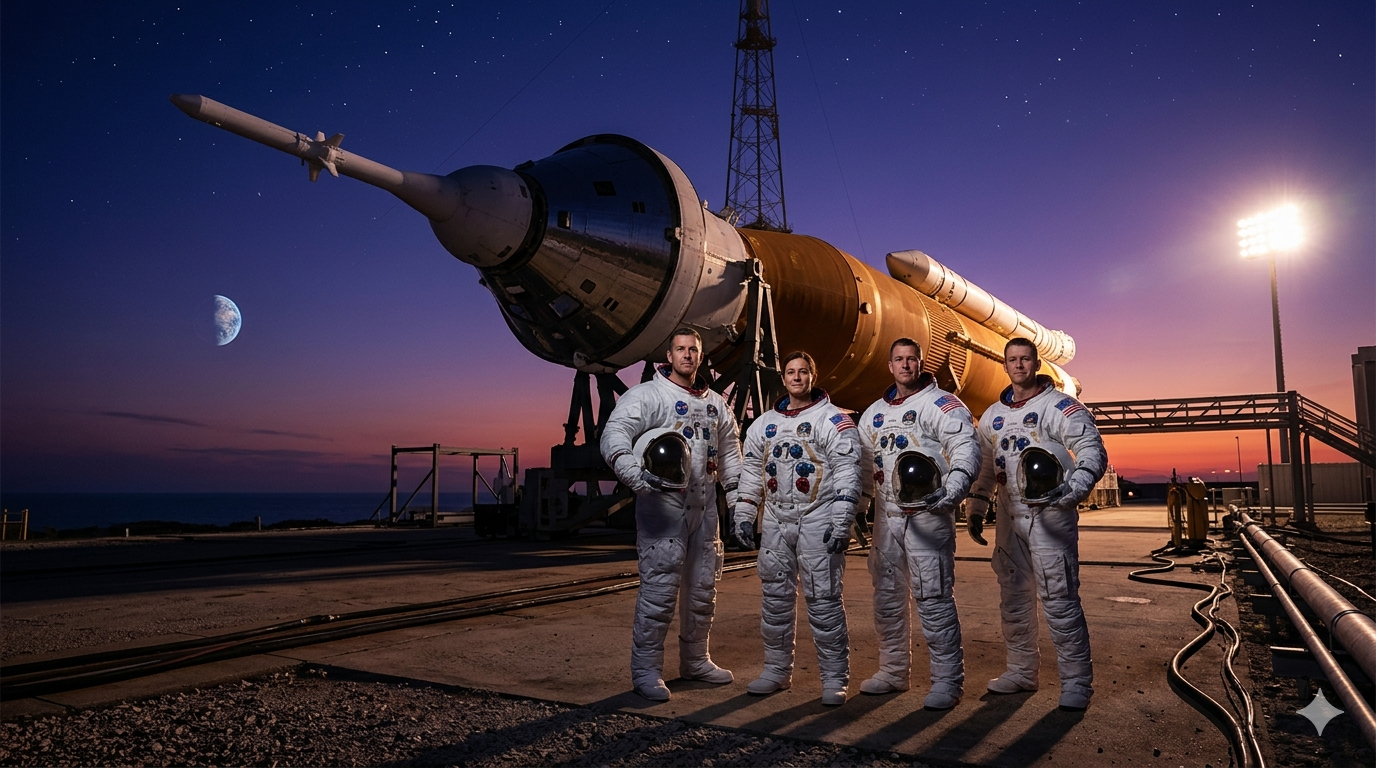
Imagine traveling a quarter million miles from home, circling a world where humans last walked over 50 years ago, and coming back alive to tell the story. That is exactly what four astronauts are preparing to do as part of NASA's Artemis II mission — and the world is watching with the same electricity that surrounded the Apollo era.
This is not science fiction. This is not a simulation. NASA's Artemis programme is humanity's real, active effort to return to the Moon, establish a lasting presence there, and eventually use the Moon as a stepping stone toward Mars. Artemis II is the second step in that journey — and the one that puts human beings back in deep space for the first time in more than five decades.
The Artemis II Crew — Four Astronauts Making History
The crew of Artemis II is not just four trained professionals. Each person represents a milestone that goes beyond the mission itself.
| Astronaut | Role | Agency | Historic Achievement |
|---|---|---|---|
| Reid Wiseman | Commander | NASA | Veteran ISS commander. Leads the mission with deep-space experience |
| Victor Glover | Pilot | NASA | First Black astronaut assigned to a Moon-bound mission in history |
| Christina Koch | Mission Specialist | NASA | First woman assigned to travel to the Moon. Holds the ISS stay record for women |
| Jeremy Hansen | Mission Specialist | Canadian Space Agency | First Canadian assigned to a crewed lunar mission |
What Will Artemis II Actually Do?
The mission follows a free-return trajectory around the Moon. The Orion spacecraft will carry the crew approximately 8,900 kilometres beyond the Moon's far side — farther than any human has traveled in 50 years. Lunar gravity then bends their path back toward Earth in a natural arc that requires no additional propulsion for the return journey.
The crew will not land. The mission is a critical systems test. Every life support, navigation, communication, and crew performance system must work perfectly in the deep-space radiation environment before anyone attempts to step on the lunar surface. Think of it as the most extreme test drive in human history — but the vehicle is a spacecraft and the test track is the Moon's orbit. The total mission duration is approximately 10 days from launch to splashdown. According to NASA's official Artemis programme page, this flight is an essential prerequisite for Artemis III's crewed Moon landing.
The Orion Spacecraft — Built for Deep Space Survival
The Orion Multi-Purpose Crew Vehicle is not a shuttle or a Soyuz. It is specifically designed for the harsh environment beyond low Earth orbit. The spacecraft features radiation shielding that far exceeds the ISS, a life support system capable of sustaining four crew members for over 21 days, and a heat shield rated for reentry speeds of 40,000 kilometres per hour from lunar return trajectories.
Launched on the Space Launch System (SLS) — NASA's most powerful rocket ever built, generating 8.8 million pounds of thrust — Orion is the product of decades of engineering lessons from Apollo, Space Shuttle, and commercial crew programmes combined into one purposefully designed deep-space crew vehicle.
From Artemis II to Artemis III — The Road to the Moon's Surface
If Artemis II succeeds, Artemis III will be the mission where history truly repeats itself. A different crew will land near the Moon's south pole using a Human Landing System built by SpaceX. The south pole is targeted because permanently shadowed craters there contain water ice — a resource that could be used to produce rocket fuel and support long-term lunar habitation. The Artemis programme is not just about returning to the Moon. It is about staying there.