Content options
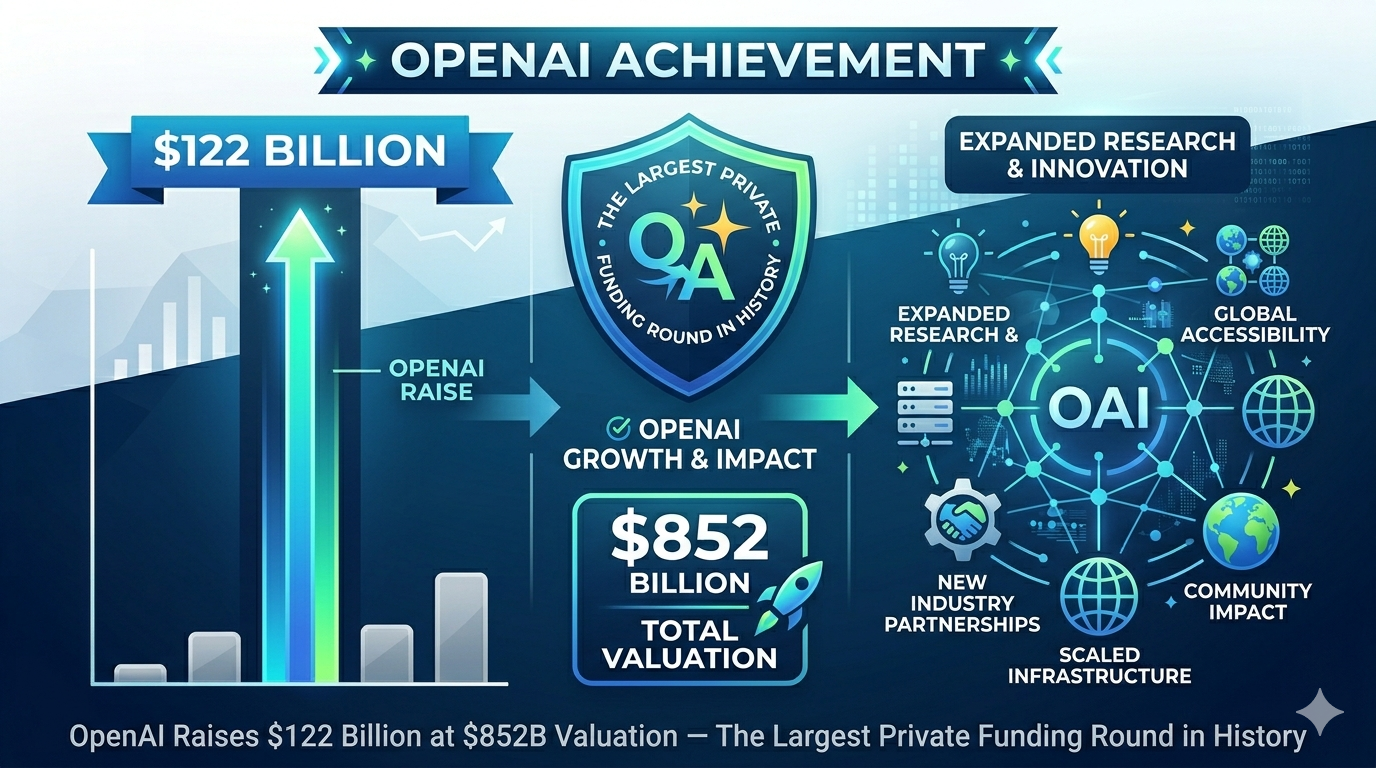
There is a number that keeps getting larger. On March 31, 2026, OpenAI closed its latest funding round with $122 billion in committed capital and a post-money valuation of $852 billion. To put that in perspective: OpenAI is now valued higher than the GDP of most countries. It is worth more than ExxonMobil, JPMorgan Chase, and Visa combined. And it has not yet issued a single share on a public market.
This is not just a funding story. It is a story about how quickly an AI company can grow from a research nonprofit into the most valuable private technology company in human history — and what it now has to prove to justify a number that staggers even the most seasoned investors on Wall Street.
Who Invested and How Much?
The $122 billion figure was largely accomplished by securing capital from Amazon, Nvidia, and SoftBank. According to Bloomberg, Amazon invested $50 billion, while the other two companies invested $30 billion each. But the composition of the round tells a deeper story than the headline number.
Amazon's $50 billion investment is not purely financial. It comes bundled with an expanded cloud agreement worth an additional $100 billion over eight years, and a deal making Amazon Web Services the exclusive third-party cloud provider for OpenAI Frontier, the company's enterprise platform for building and managing AI agents. Amazon's involvement includes an agreement that OpenAI will use two gigawatts of computing capacity powered by Amazon Trainium chips. This is compute at infrastructure scale — the kind of arrangement that underpins decades of cloud strategy, not just a venture bet.
| Investor | Amount | Strategic Angle |
|---|---|---|
| Amazon (AWS) | $50B ($15B initial + $35B conditional) | Exclusive cloud provider for OpenAI Frontier; 8-year compute agreement |
| Nvidia | $30B | Deepened compute partnership; chip supply alignment |
| SoftBank | $30B (co-lead) | Financial return; AI ecosystem positioning |
| Microsoft | Undisclosed | Continued long-term partnership; Azure remains primary API cloud |
| a16z, D.E. Shaw, MGX, TPG, T. Rowe Price | Remaining capital | Financial return and portfolio positioning |
| Individual investors | $3B+ | Retail access via bank channels; ARK Invest ETF inclusion |
The Business Behind the Valuation
At $852 billion, OpenAI cannot be judged on potential alone. The market is already asking whether its revenue trajectory can sustain a valuation that exceeds the GDP of most countries. The numbers are real but the gap between revenue and valuation remains enormous.
GPT-5.4 is driving record engagement across agentic workflows. OpenAI's APIs now process more than 15 billion tokens per minute. Codex now serves over 2 million weekly users, up 5x in the past three months, with usage growing more than 70% month over month. Enterprise momentum is particularly strong: the enterprise business is growing too, now contributing more than 40% of its revenue, and on track to reach parity with consumer revenue by the end of 2026.
The company frames its compute investment as infrastructure-building on a societal scale. The company compared the capital investment to building electricity grids or highway systems. It is an ambitious frame — and one that will need to be validated by sustained revenue growth over the next several years.
OpenAI is becoming the core infrastructure for AI, making it possible for people around the world and businesses, big and small, to just build things.
OpenAI Official Funding Announcement, March 31, 2026The IPO Path and What Comes Next
This round reads less like conventional venture financing and more like IPO groundwork. For the first time, OpenAI extended participation to individual investors through bank channels, raising $3 billion from retail participants. It will also be included in several ARK Invest ETFs, giving even more people indirect access to the private company's stock. It is likely that the company will issue an initial public offering before the end of the year. According to Reuters, the company is preparing for an IPO as soon as the second half of 2026.
There are also real risks. OpenAI shut down Sora, its video generation product, after user engagement fell and a Disney licensing deal collapsed. The company remains unprofitable despite its $2 billion monthly revenue. And the $35 billion contingent portion of Amazon's commitment is tied to OpenAI either going public or achieving artificial general intelligence — a condition that concentrates risk around the IPO timeline.