Content options
El Nino is a warming of the central and eastern Pacific Ocean that often, though not always, weakens the Indian monsoon. According to The Indian Express, Union Minister CR Patil said Gujarat is ready to trade electricity or money for water because of El Nino. For households, the practical meaning is simple: a weaker monsoon can mean tighter reservoirs, costlier water and more pressure on the power grid.
This explainer covers what El Nino is, why a water-for-electricity swap makes sense on paper, who feels the impact first, and what you can do at home. We have kept news details to what the headline supports, because the full terms of any arrangement were not part of our source notes.
Key takeaways
- El Nino raises the odds of a weak or erratic monsoon in India, but it does not guarantee a drought.
- Gujarat's reported offer of power or money for water signals that the state sees a real supply risk, though the details are not confirmed in our notes.
- Farmers feel the shock first. City taps and electricity bills are affected later and more indirectly.
- Cutting household water use by even a fifth is realistic, and it also lowers pumping costs.
What is El Nino, in plain words?
Every few years, surface water in the central and eastern Pacific Ocean becomes warmer than normal. That changes where heat and moisture rise into the atmosphere, and it disturbs wind patterns across the tropics. The disturbance reaches the Indian Ocean region as well.
El Nino typically returns every two to seven years and can last several months to a year. The opposite phase, La Nina, usually brings better rain to India. Forecasters such as the India Meteorological Department track both, and you can read its latest outlooks at mausam.imd.gov.in.
How does El Nino affect the Indian monsoon?
The monsoon depends on a temperature contrast between the land and the surrounding oceans. When the Pacific runs warm, air tends to sink over parts of South Asia, which can suppress rainfall or lengthen dry spells within the season.
The link is a tendency, not a rule. Several El Nino years, including 2009 and 2015, saw deficient rain in India. Other El Nino years, such as 1997, ended with a near-normal monsoon, partly because other ocean patterns, like the Indian Ocean Dipole, pulled the other way.
Distribution also matters as much as the total. A season can end with a near-normal count but still leave a district dry if the rain arrives in two or three heavy bursts. Gujarat, with large semi-arid stretches in Saurashtra and Kutch, is sensitive to exactly that pattern.
Why would Gujarat offer electricity or money for water?
The headline says Gujarat is ready to trade electricity or money for water. It does not tell us who would supply the water, how much, or on what terms. What follows is general logic, not a description of a confirmed deal.
Gujarat relies heavily on the Narmada, with the Sardar Sarovar Dam at its centre. The Narmada canal and pipeline network carries drinking water to a large part of the state and also feeds irrigation schemes. A shortfall in the river's catchment hurts both uses. A likely source of extra water would be upstream Narmada reservoirs in neighbouring states, but that is our inference, not something the headline states.
The swap itself is easy to understand. Water is scarce for Gujarat, while electricity is something the state can generate, buy or share. A state with surplus generation capacity, or one that needs power at certain hours, may find a barter or a payment more acceptable than a plain request. Money offers the same logic in cash form.
For you, the useful signal is this: when governments start discussing trades, the water gap is being taken seriously at the planning level, well before taps run dry.
What could happen to reservoirs and farmers?
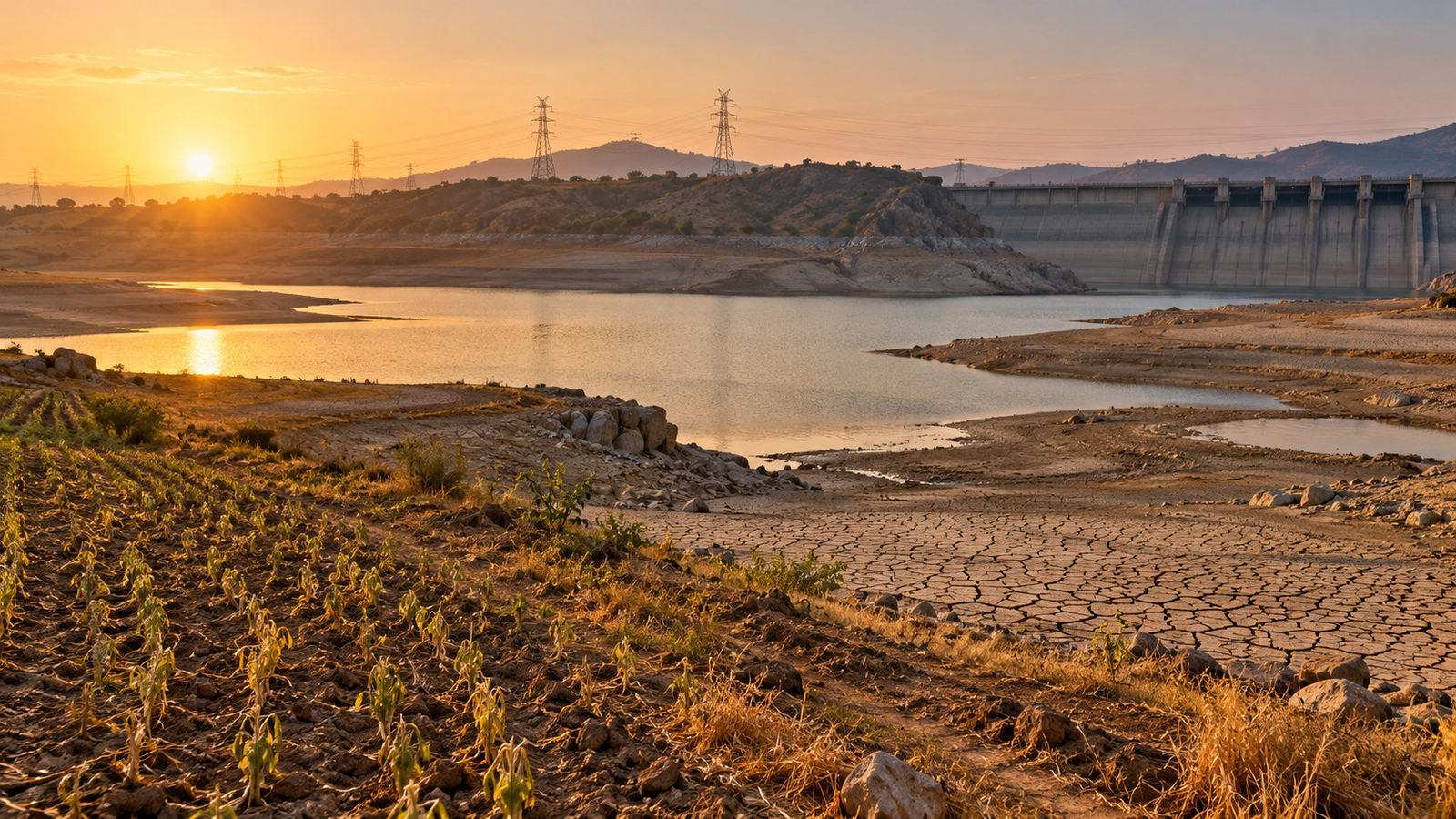
Reservoirs are the buffer. A good monsoon fills them, and the stored water is then released through the year for drinking, irrigation and power. In a weak year the buffer shrinks, and every user competes for a smaller pool.
Authorities usually protect drinking water first. That leaves irrigation as the flexible demand, which is why farmers feel the pinch earliest. Typical responses include fewer canal releases for the rabi (winter) crop, advice to switch to less thirsty crops, and more reliance on borewells.
Borewells bring their own problem. When more farmers pump from the ground, water tables fall, and pumps must lift water from deeper levels. That uses more electricity per litre, which links the water problem straight back to the power grid.
Who is exposed most?
- Rainfed farmers with no canal or well backup, since their crop depends on the sky.
- Cotton, groundnut and castor growers in dry belts, where a long gap between rains can damage the crop.
- Small towns and villages that depend on a single local source rather than the Narmada grid.
- Apartment residents who depend on tanker supply when municipal supply falls short.
How does El Nino affect electricity?
The effect runs through four channels. First, hotter and drier weather raises demand for fans, coolers and air conditioners. Second, farmers run irrigation pumps for longer when rain fails. Third, hydropower output falls when reservoirs are low. Fourth, thermal power stations need large volumes of cooling water, so a water shortage can complicate their operation too.
When the cheapest supply (hydro) is weaker and demand is higher, utilities buy or generate costlier power. In Gujarat, consumer bills carry a fuel and power purchase price adjustment, which can move up when the cost of buying power rises. Global fuel prices feed into this as well. If you want the background on why energy chokepoints matter, see our explainer on the Strait of Hormuz, and for how oil supply decisions ripple outward, our guide to OPEC.
Whether your own bill rises depends on the tariff order and the adjustment in force, not on El Nino alone. Check the line items on your bill rather than assuming.
Will my city water supply be cut?
Not automatically. Large cities served by the Narmada pipeline network and big reservoirs usually have a cushion of several months. The more likely changes are shorter supply hours, lower pressure in tail-end areas, and rising tanker prices in neighbourhoods that already depend on tankers.
Tanker rates are the first place you will notice stress, because private suppliers raise prices quickly when demand jumps. Whether a rate rises 10 percent or 50 percent depends on your locality and how long the shortage lasts, so we will not guess a number.
How much water does a household actually use?
Urban planning norms in India commonly assume about 135 litres per person per day for domestic use. That is a planning benchmark, not what every household uses, but it is a handy yardstick.
Worked example: a family of four
At the benchmark, 4 people × 135 litres = 540 litres a day, or about 16,200 litres a month (540 × 30).
Now take one habit. A 10-minute shower at roughly 10 litres a minute uses about 100 litres. A bucket bath uses perhaps 20 litres. The saving per bath is about 80 litres. For four people bathing daily, that is 80 × 4 = 320 litres a day, or 9,600 litres over 30 days. Shower flow varies by fitting, so measure your own by timing how long a bucket takes to fill.
Worked example: what pumping costs you
Suppose a 0.75 horsepower pump lifts water to your overhead tank. Converting, 0.75 × 0.746 is about 0.56 kW. Running it one hour a day uses roughly 0.56 units, or 0.56 × 30 = 16.8 units a month. At an illustrative ₹6 per unit, that is about ₹100 a month. Your actual tariff will differ, so replace ₹6 with the rate on your bill.
The figure is small, but the point is direction. Less wasted water means less pumping, and in a hot summer that is one fewer drain on your bill and on the grid.
Which water-saving steps matter most?
Most advice is generic. These steps are ranked by how much they usually save, based on where household water goes: bathing, toilets, laundry, kitchen and washing vehicles or floors.
- Fix leaks first. A dripping tap or running cistern can waste many litres a day, and a plumber visit costs less than months of loss.
- Switch to bucket baths or a low-flow showerhead. Bathing is often the largest single use.
- Use dual-flush or a smaller cistern setting. Toilets are a major slice of indoor use.
- Run washing machines only on full loads. Reuse the final rinse water for mopping floors or flushing where practical.
- Collect RO reject water. If you have an RO purifier, the waste water is fine for cleaning, plants and mopping.
- Water plants early or late. Less evaporates, so you use less.
- Wash vehicles with a bucket and cloth, not a running hose.
A quick household checklist
- Check the water meter or tank level overnight with no one using water. A drop means a leak.
- Put a drop of food colouring in the cistern. If it shows in the bowl without flushing, it leaks.
- Confirm your overhead tank has a working float valve so it does not overflow.
- Keep a stored reserve of drinking water for a couple of days, without hoarding more than you need.
Myth versus fact
Myth: El Nino always means drought. Fact: It raises the odds of a weak monsoon, but outcomes vary by year and region.
Myth: If your city has Narmada water, you are safe. Fact: Supply hours and pressure can still change if the source is under strain.
Myth: Saving water is only about taps. Fact: Pumping, heating and treating water all use electricity, so household savings reach the power bill too.
Could prices rise beyond water and power?
A poor monsoon can lift prices of vegetables, pulses and edible oils when crops suffer, which feeds into overall inflation. If you want a clear baseline on how that works, read our guide on what inflation is. Watch food prices over the coming months rather than assuming a fixed jump.
Frequently asked questions
Is El Nino confirmed for 2026?
Our source notes only carry the news headline, so we cannot confirm forecast details. Check the India Meteorological Department and international forecasters for the latest status and outlook, since they update regularly.
What exactly did CR Patil say?
According to The Indian Express headline, he said Gujarat is ready to trade electricity or money for water, hit by El Nino. We do not have the full statement, so we have not described terms, partners or quantities.
Will my electricity bill go up because of El Nino?
It may, if higher demand and costlier power purchases push up the fuel and power adjustment. The effect depends on your tariff and the adjustment in force, so check your bill rather than relying on a general claim.
How can I tell if my area is at risk of a water shortage?
Watch for shorter supply hours, falling pressure and rising tanker rates. Your municipal corporation or water supply board is the place to ask about reservoir levels and any planned schedules.
Does harvesting rainwater help in a weak monsoon year?
It helps only if some rain falls. Even a few good spells can recharge a tank or borewell, so setting up a simple system before the season gives you a better chance of capturing what does come.
Bottom line
El Nino raises the risk of a tight water year, and the reported offer to trade power or money for water suggests Gujarat is planning for it. For most households the effect will be gradual: shorter supply, costlier tankers and slightly higher bills rather than a sudden cut-off. Start this week with a leak check and one habit change, such as bucket baths, then track the monsoon outlook on the IMD site.