Content options
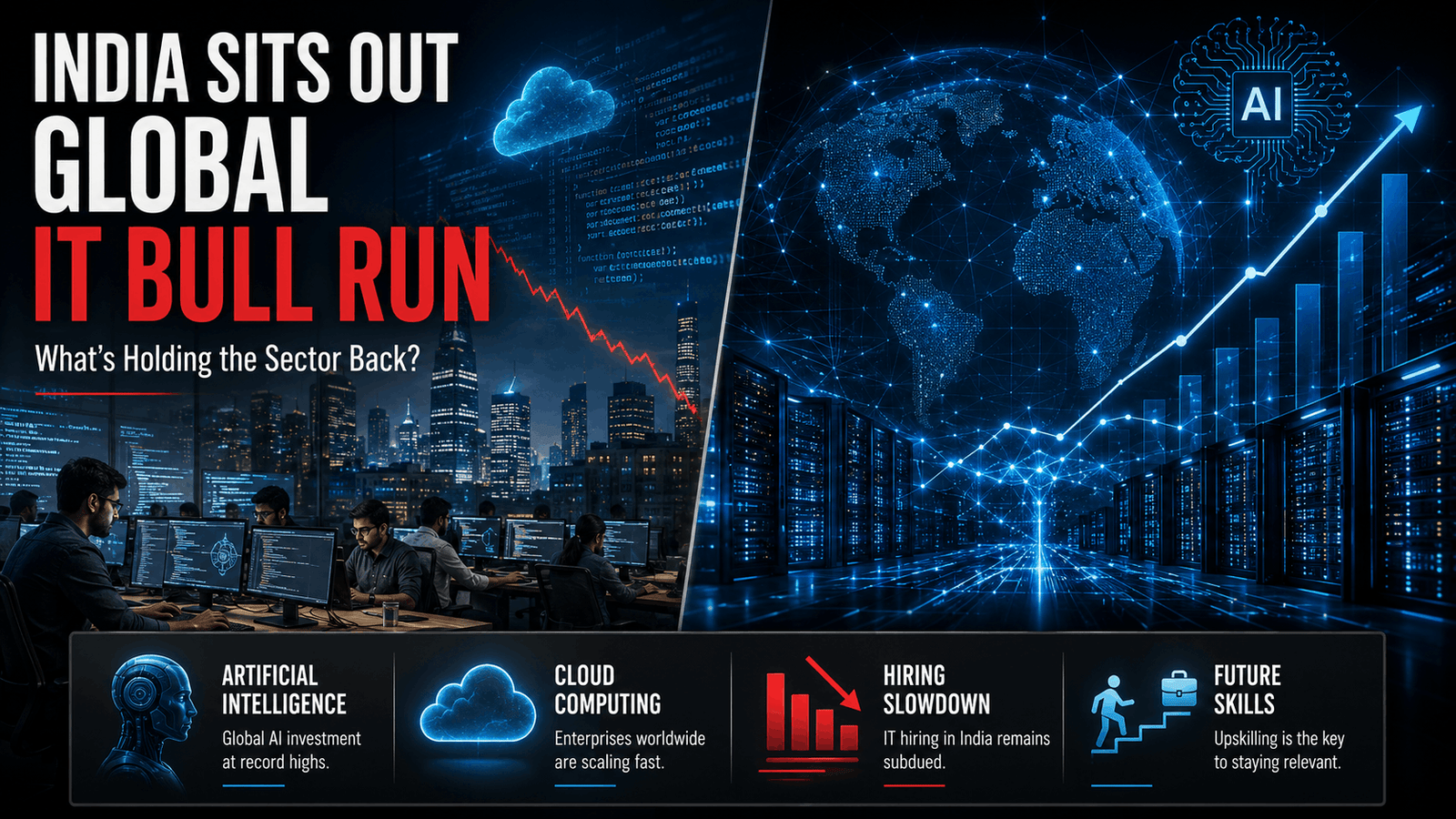
India Sits Out Global IT Bull Run: What's Holding the Sector Back?
Introduction
For decades, India's information technology (IT) industry has been one of the country's biggest economic success stories. Companies such as TCS, Infosys, Wipro, HCLTech, and Tech Mahindra have built strong global reputations by providing software development, consulting, cloud services, and business process outsourcing to clients around the world.
However, while technology investments in areas like artificial intelligence (AI), cloud computing, cybersecurity, and automation continue to grow globally, India's traditional IT services sector is experiencing slower growth, cautious hiring, and increased pressure to adapt.
So, why is India's IT industry not benefiting from the current global technology boom in the same way as some international technology companies?
Understanding the Global Tech Boom
Despite economic uncertainty, businesses worldwide continue to invest heavily in:
- Artificial Intelligence (AI)
- Cloud Computing
- Cybersecurity
- Data Analytics
- Digital Transformation
- Automation
Global technology companies are focusing on innovation and long-term growth, particularly in AI-driven products and enterprise software.
Why Is India's IT Sector Growing More Slowly?
Several factors are contributing to the slowdown.
1. Reduced Client Spending
Many businesses in North America and Europe are being cautious with IT budgets because of economic uncertainty.
Companies are delaying large digital transformation projects and focusing only on essential technology investments.
2. AI Is Changing Traditional IT Services
Generative AI and automation tools can now complete some tasks that previously required large development teams.
Rather than replacing software engineers entirely, AI is changing the types of skills companies require.
Demand is increasing for professionals with expertise in:
- AI Engineering
- Machine Learning
- Cloud Architecture
- Cybersecurity
- Data Engineering
3. Slower Hiring
Several major Indian IT companies have reported slower hiring compared to previous years.
Instead of rapid expansion, many companies are prioritizing:
- Internal upskilling
- Productivity improvements
- AI adoption
- Cost optimization
4. Global Economic Uncertainty
Higher interest rates and slower economic growth in key international markets have reduced technology spending by many enterprises.
Since a significant portion of India's IT revenue comes from overseas clients, global conditions directly affect business performance.
Is AI a Threat or an Opportunity?
AI is often viewed as a disruption, but it also creates new opportunities.
Growing demand includes:
- AI Application Development
- AI Integration
- Prompt Engineering
- Cloud Infrastructure
- Data Security
- AI Governance
Companies that adapt quickly may benefit from these emerging markets.
New Growth Areas
India's technology sector continues to have strong opportunities in:
- Artificial Intelligence
- Semiconductor Design
- Global Capability Centres (GCCs)
- Cloud Computing
- FinTech
- HealthTech
- SaaS Products
- Cybersecurity
These segments are expected to drive future investment and employment.
What Does This Mean for IT Professionals?
Professionals may benefit from focusing on continuous learning.
Skills likely to remain in demand include:
- AI & Machine Learning
- Cloud Platforms (AWS, Azure, Google Cloud)
- Cybersecurity
- DevOps
- Data Analytics
- UI/UX Design
- Product Management
Adaptability is becoming just as important as technical expertise.
Future Outlook
Although growth has slowed in some traditional outsourcing services, India's technology ecosystem remains one of the largest in the world.
Continued investment in innovation, digital infrastructure, startups, and emerging technologies could position the industry for long-term growth.
Success will depend on how quickly businesses and professionals adapt to changing market demands.
Blog of Time Insight
India's IT industry is not in decline—it is undergoing a period of transformation. As global demand shifts toward AI, cloud computing, cybersecurity, and digital products, companies and professionals who embrace new technologies and continuously upgrade their skills are likely to be better positioned for future opportunities.
Key Takeaways
✅ Global technology investment remains strong.
✅ India's traditional IT services market is facing slower growth.
✅ AI is reshaping technology roles rather than eliminating them entirely.
✅ Upskilling is becoming increasingly important.
✅ Emerging technologies continue to create new business opportunities.
Conclusion
India's IT sector has successfully navigated multiple technological shifts over the past three decades. The current transition toward AI and digital transformation represents another important turning point. While the industry faces short-term challenges, continued innovation, investment, and workforce upskilling can help maintain India's position as a global technology leader.