Content options
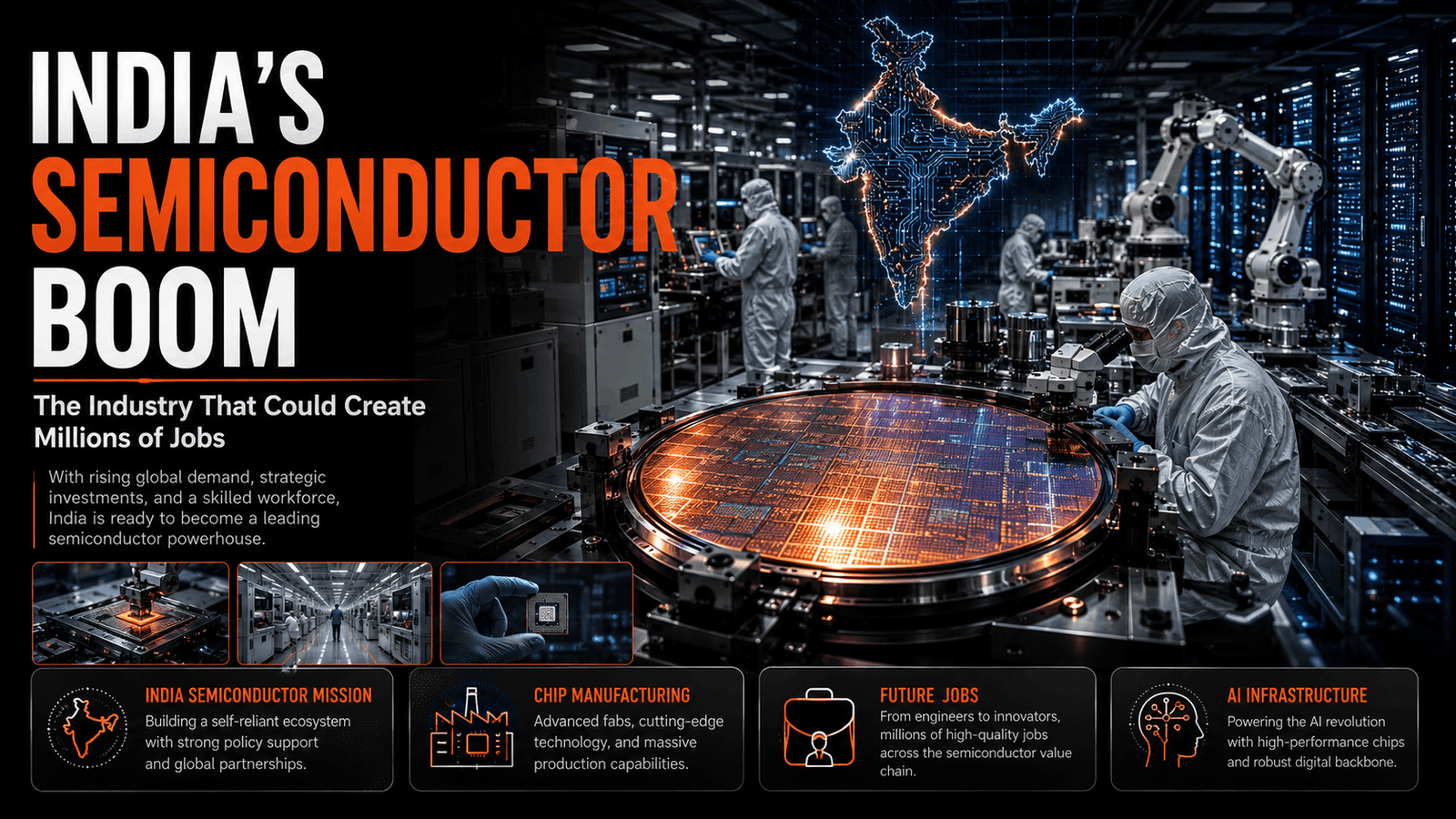
Why India's Semiconductor Industry Could Create Millions of Jobs
Introduction
Every smartphone, laptop, electric vehicle, smart TV, medical device, and AI server depends on one tiny but incredibly powerful component—the semiconductor chip.
For decades, countries like Taiwan, South Korea, the United States, and China have dominated chip manufacturing. Today, however, India is making one of its biggest technology bets yet.
Backed by billions of dollars in government incentives and major investments from companies such as Tata Electronics, Micron, HCL-Foxconn, CG Power, and several global technology partners, India is laying the foundation for a world-class semiconductor ecosystem.
This isn't just about building factories. It is about creating a complete industry that could generate millions of direct and indirect jobs, strengthen India's manufacturing sector, reduce dependence on imports, and position the country as a key player in the global technology supply chain.
The coming decade could become one of the most significant chapters in India's industrial history.
What Exactly Is a Semiconductor?
A semiconductor is the tiny electronic chip that powers almost every modern device.
You'll find semiconductor chips inside:
📱 Smartphones
💻 Laptops
🚗 Cars and Electric Vehicles
📺 Smart TVs
⌚ Smartwatches
🏥 Medical Equipment
🤖 Artificial Intelligence Servers
🚀 Satellites
Without semiconductors, today's digital economy simply wouldn't function.
As AI, cloud computing, electric vehicles, and 5G networks continue to grow, global demand for advanced semiconductor chips is expected to rise dramatically.
Why Is India Investing So Heavily?
India currently imports a large portion of the semiconductor chips used in electronics manufacturing.
That creates several challenges:
- Heavy dependence on foreign suppliers
- Higher production costs
- Supply chain risks during global disruptions
- Limited domestic manufacturing capability
To address these issues, the Government of India launched the India Semiconductor Mission, a long-term initiative designed to encourage chip manufacturing, semiconductor packaging, design, and research within the country.
Combined with Production Linked Incentive (PLI) schemes and state-level support, the goal is to make India a globally competitive semiconductor manufacturing destination.
The Companies Driving India's Chip Revolution
Several major companies have already announced multi-billion-dollar investments in India's semiconductor ecosystem.
Tata Electronics
Tata Group has become one of India's biggest semiconductor investors.
The company is developing advanced semiconductor manufacturing and packaging facilities while partnering with global technology companies to strengthen India's chip ecosystem.
Its long-term vision extends beyond manufacturing to include semiconductor design, assembly, testing, and advanced electronics production.
Micron Technology
US-based Micron is establishing one of India's first major semiconductor assembly and testing facilities.
The investment is expected to accelerate India's role in memory chip manufacturing while creating thousands of skilled jobs.
It also represents one of the largest foreign technology investments in India's semiconductor sector.
HCL–Foxconn
HCL and Foxconn are collaborating to establish semiconductor manufacturing capabilities in India.
Foxconn already plays a major role in global electronics manufacturing, making this partnership particularly significant for India's ambitions in the chip industry.
CG Power
CG Power has also entered the semiconductor space by investing in manufacturing facilities that will support India's growing electronics industry.
The company aims to strengthen India's domestic supply chain while contributing to the country's long-term manufacturing goals.
Why Global Companies Are Looking at India
India offers several advantages that make it an attractive destination for semiconductor investments:
✅ One of the world's largest engineering talent pools
✅ Rapidly growing electronics market
✅ Strong government incentives
✅ Expanding infrastructure
✅ Competitive manufacturing costs
✅ Stable long-term demand for technology products
For many global companies, India represents both a manufacturing base and a rapidly expanding consumer market.
The AI Boom Is Accelerating Demand
Artificial Intelligence has dramatically increased global demand for semiconductor chips.
Every AI model requires enormous computing power.
That means:
- AI data centers need advanced processors.
- Cloud computing platforms require thousands of specialized chips.
- Autonomous vehicles depend on high-performance semiconductors.
- Robotics, healthcare, and industrial automation all require increasingly sophisticated hardware.
As AI adoption continues to grow, semiconductor manufacturing is expected to become even more strategically important.
India's Biggest Opportunity
Unlike previous technology revolutions where India mainly provided software services, the semiconductor industry gives the country an opportunity to become a major manufacturing hub as well.
If successful, India could play an important role across the entire semiconductor value chain—from chip design and packaging to testing, manufacturing, and advanced electronics production.
Which States Could Benefit the Most?
India's semiconductor revolution will not be limited to one city or one factory. Multiple states are positioning themselves as future technology and manufacturing hubs by offering land, infrastructure, power supply, and incentives to investors.
Some of the leading states include:
Gujarat
Often called the front-runner in India's semiconductor ambitions, Gujarat has attracted several large-scale semiconductor and electronics manufacturing projects. Its industrial ecosystem, ports, and logistics network make it an attractive destination for global investors.
Tamil Nadu
Already known as India's automobile and electronics manufacturing hub, Tamil Nadu is expected to play a major role in semiconductor packaging, electronics assembly, and exports.
Karnataka
Home to Bengaluru—India's technology capital—Karnataka has a strong semiconductor design ecosystem. Many global chip design companies already operate engineering centers here.
Uttar Pradesh
The state is rapidly attracting electronics manufacturing investments, making it another important player in India's semiconductor ecosystem.
Maharashtra
Mumbai and Pune continue to attract technology companies, research centers, and advanced manufacturing investments that support the semiconductor value chain.
💼 How Many Jobs Could Be Created?
The semiconductor industry isn't just about engineers in clean rooms.
It creates employment across the entire value chain.
Direct Jobs
- Semiconductor Engineers
- Chip Design Engineers
- Manufacturing Engineers
- Quality Engineers
- Equipment Engineers
- Process Engineers
- Packaging Specialists
- Testing Engineers
Indirect Jobs
- Construction
- Logistics
- Supply Chain
- Security
- Facility Management
- Transportation
- Software Development
- AI Infrastructure
- Electronics Manufacturing
- Research & Development
For every high-tech semiconductor facility, thousands of additional jobs are created through suppliers, infrastructure development, education, housing, and local businesses.
🎓 Skills That Will Be in High Demand
Students and professionals looking to enter this industry should consider developing skills in:
- Semiconductor Engineering
- Electronics & Communication
- VLSI Design
- Embedded Systems
- PCB Design
- Chip Verification
- Python Programming
- C/C++
- AI Hardware
- Robotics
- Industrial Automation
- Data Analysis
Professionals with experience in manufacturing, electrical engineering, quality assurance, and automation are also likely to find growing opportunities.
📊 Semiconductor Career Opportunities
| Career | Growth Potential | Demand |
|---|---|---|
| Chip Design Engineer | ⭐⭐⭐⭐⭐ | Very High |
| VLSI Engineer | ⭐⭐⭐⭐⭐ | Very High |
| Embedded Engineer | ⭐⭐⭐⭐☆ | High |
| Manufacturing Engineer | ⭐⭐⭐⭐⭐ | Very High |
| Quality Engineer | ⭐⭐⭐⭐☆ | High |
| Equipment Engineer | ⭐⭐⭐⭐☆ | High |
| Automation Engineer | ⭐⭐⭐⭐⭐ | Very High |
| AI Hardware Engineer | ⭐⭐⭐⭐⭐ | Very High |
🌍 Why This Matters Beyond Technology
A successful semiconductor industry could strengthen India's economy in several ways:
- Reduce dependence on imported chips.
- Support the growing electric vehicle industry.
- Strengthen AI infrastructure.
- Improve national supply chain resilience.
- Attract additional foreign investment.
- Encourage innovation and research.
- Create high-value manufacturing jobs.
- Boost exports of electronics and technology products.
Rather than relying mainly on software exports, India has an opportunity to become a significant player in advanced manufacturing as well.
🔮 What Could the Next Decade Look Like?
Industry experts believe the coming years could reshape India's technology landscape.
If current investments continue and new projects become operational, India could gradually expand its role in:
- Chip manufacturing
- Semiconductor packaging
- Testing facilities
- Chip design
- AI hardware
- Automotive electronics
- Consumer electronics
- Telecom infrastructure
While competing directly with long-established semiconductor leaders will take time, today's investments could lay the foundation for sustained growth over the next decade.
⭐ Blog of Time Insight
India's semiconductor mission is about far more than building factories. It represents a strategic shift toward becoming a global technology manufacturing nation. Combined with strengths in software, AI, engineering talent, and digital infrastructure, a successful semiconductor ecosystem could create long-term opportunities for businesses, professionals, and students alike. The journey will take time, but the direction is becoming increasingly clear.
✅ Key Takeaways
✔ India is investing heavily in semiconductor manufacturing and advanced electronics.
✔ Major companies such as Tata Electronics, Micron, and HCL–Foxconn are helping build the ecosystem.
✔ The industry has the potential to create large numbers of direct and indirect jobs.
✔ Skills in electronics, VLSI, AI hardware, automation, and embedded systems are likely to remain in high demand.
✔ Semiconductors are becoming one of the most important strategic industries for India's future economy.
📌 Conclusion
Semiconductors power almost every modern technology—from smartphones and electric vehicles to AI systems and medical devices. As India strengthens its domestic manufacturing capabilities through government support and private investment, the country has an opportunity to become an increasingly important part of the global semiconductor supply chain.
For students, engineers, entrepreneurs, and investors, this transformation represents more than a technology story. It is a long-term economic opportunity that could influence careers, innovation, manufacturing, and India's position in the global technology landscape for years to come.
❓Frequently Asked Questions
1. What is a semiconductor?
A semiconductor is a material used to manufacture electronic chips that power devices such as smartphones, computers, vehicles, medical equipment, and AI servers.
2. Why is India investing in semiconductor manufacturing?
India aims to strengthen domestic manufacturing, reduce import dependence, improve supply chain resilience, and support future industries such as AI, EVs, and advanced electronics.
3. Which companies are investing in India's semiconductor sector?
Several companies, including Tata Electronics, Micron, HCL–Foxconn, and CG Power, have announced major investments in India's semiconductor ecosystem.
4. What careers are expected to grow?
VLSI engineering, chip design, embedded systems, manufacturing engineering, AI hardware, automation, testing, and quality engineering are among the promising career paths.
5. Is the semiconductor industry a good career choice?
The industry is expected to offer strong long-term opportunities as demand for chips continues to grow across multiple sectors.