Content options
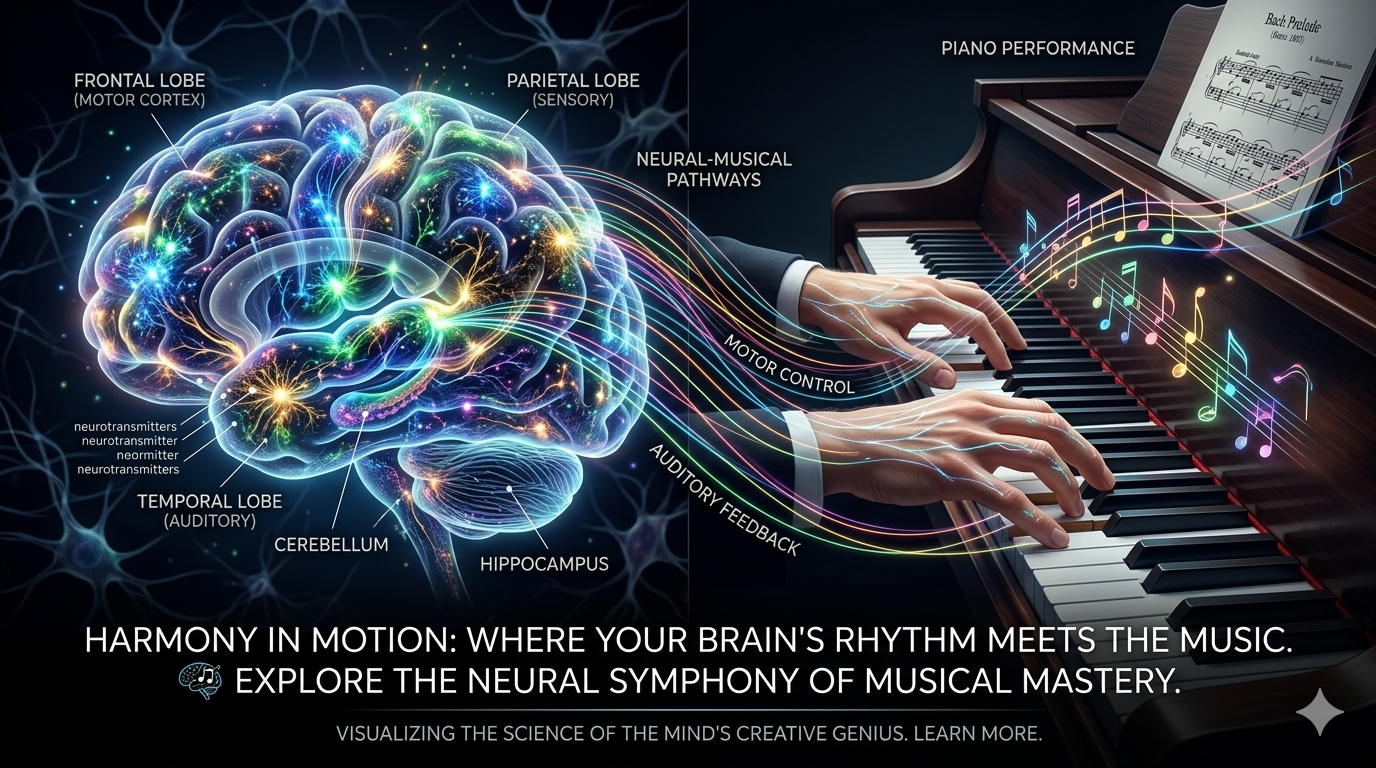
Neuroscientist Anita Collins described the brain of a musician as a "fireworks show" compared to a listener's response. When you listen to music, specific areas of the brain light up. When you play music — actively read notes, coordinate two hands doing different things, control breath or bow pressure, while simultaneously listening to the sound you produce — virtually the entire brain fires at once in coordinated patterns of exceptional complexity. No other human activity activates the brain so completely and simultaneously.
What Neuroscience Shows About Musicians' Brains
MRI and fMRI studies comparing the brains of musicians and non-musicians have produced remarkably consistent findings. Professional musicians show measurably larger volumes in the corpus callosum — the neural bridge connecting the brain's left and right hemispheres — which enhances cross-hemispheric communication. The cerebellum, which coordinates fine movement, is larger in musicians. The auditory cortex shows denser neural connections in people who have played instruments since childhood. According to research from Northwestern University's Auditory Neuroscience Laboratory, musicians process language more efficiently than non-musicians because musical training strengthens the same neural pathways involved in phonemic discrimination — the ability to distinguish similar sounds in speech. This is why musically trained children consistently demonstrate superior reading and language skills compared to their peers. Read more brain science at BlogofTime.com.
The Specific Brain Benefits of Playing Music
- Working memory enhancement: Reading music requires holding multiple elements in mind simultaneously — the note being played, what comes next, dynamics, tempo, and coordination across hands or breath. This constant working memory demand strengthens the brain's capacity to hold and manipulate information, improving performance on tasks far beyond music itself
- Executive function improvement: Music requires planning, attention regulation, error monitoring, and flexible adaptation — all functions of the prefrontal cortex. Regular musical practice strengthens these functions, which transfer to academic performance, professional effectiveness, and emotional self-regulation
- Emotional intelligence development: Learning to express emotion through musical dynamics — understanding that a phrase played softly with a slight ritardando conveys sadness differently from the same phrase played loudly with a forward lean — develops sophisticated emotional awareness and expression that transfers to interpersonal understanding
- Protection against dementia: Multiple longitudinal studies show that people who played musical instruments throughout their lives show significantly later onset and slower progression of dementia. Musical memory is uniquely resilient in Alzheimer's patients — many who cannot remember their children's names can still play pieces they learned decades earlier
| Brain Benefit | Research Finding | Age When Most Effective |
|---|---|---|
| Working Memory | Musicians score 20-30% higher on working memory tasks | Greatest impact when started before age 7 |
| Language Processing | Musical training improves phonemic discrimination and reading | Childhood, but benefits persist when started as adult |
| Fine Motor Control | Larger motor cortex and cerebellum volume in musicians | Progressive with years of practice at any age |
| Emotional Regulation | Musicians show better limbic-prefrontal coordination | All ages benefit from regular musical practice |
| Dementia Protection | Musicians develop dementia 2 to 4 years later on average | Cumulative effect of lifelong practice strongest |