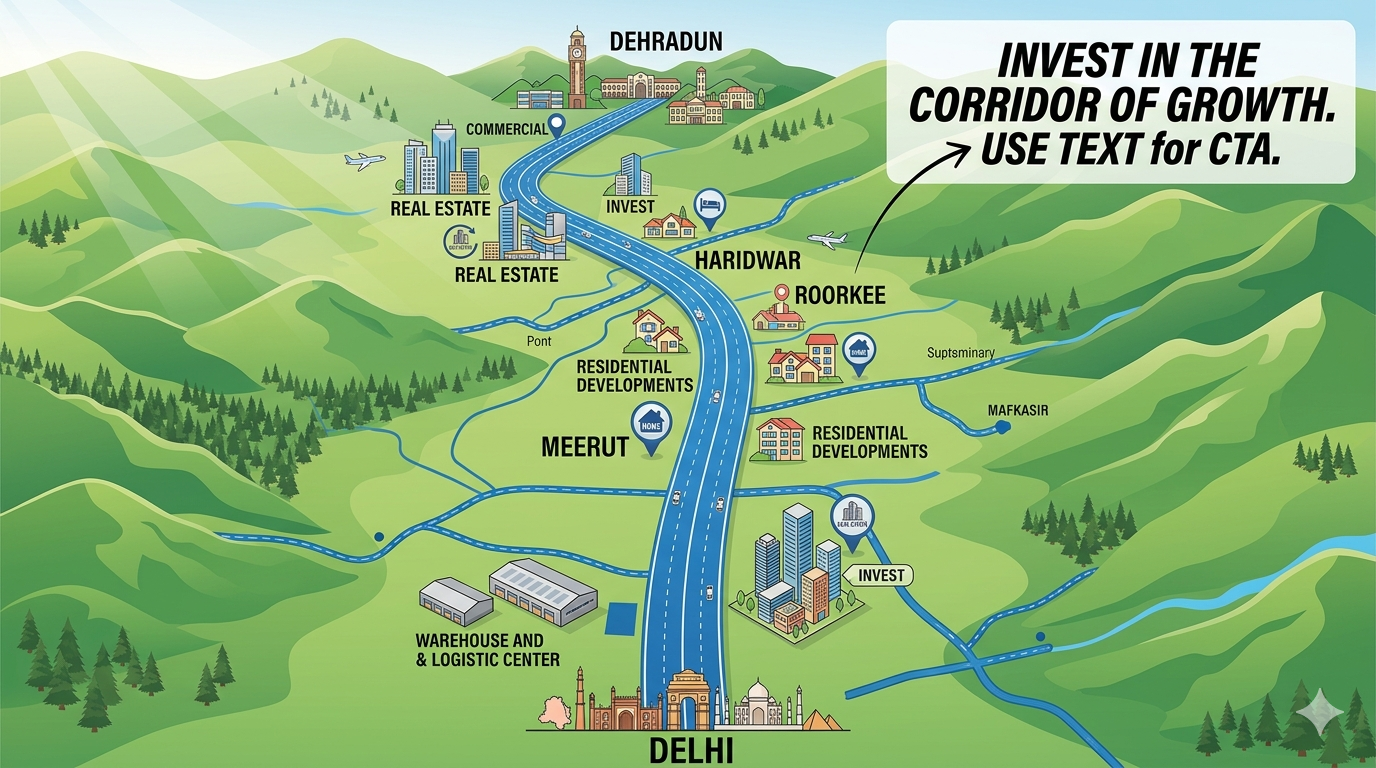
Delhi–Dehradun Expressway: real estate markets that will benefit
India's infrastructure-real estate linkage is well-established: wherever a major expressway opens, property prices in its corridor typically rise 15–40% within three to five years of completion. The Delhi–Dehradun Economic Corridor (NH-72A) is the latest — and one of the most exciting — instances of this pattern. At 210 km and six lanes, it slashes the journey from Delhi to Dehradun from a punishing 6+ hours to a comfortable 2.5 hours.
For investors and buyers, the question is not whether this will lift real estate — it is where, by how much, and in what segment.
The corridor at a glance
210 km
Total expressway length
2.5 hrs
Delhi to Dehradun travel time (from 6hrs)
₹13,000Cr+
Total project investment
20–40%
Typical property price rise near infra corridors
The Delhi–Dehradun expressway passes through Asia's largest wildlife corridor (the Shivalik elephant corridor) — a unique engineering challenge involving 12 km of elevated viaduct to allow animal crossings. This section alone has boosted eco-tourism property interest in nearby areas.
Which real estate markets will benefit most
| Location |
Distance from Delhi |
Real Estate Type |
Investment Case |
Risk Level |
| Baghpat |
~50 km |
Industrial, logistics |
Strong — warehousing demand rising |
Low-medium |
| Muzaffarnagar |
~100 km |
Agri-industrial, plots |
Moderate — slower urbanisation |
Medium |
| Saharanpur |
~150 km |
Warehouse, plotted dev. |
Strong — existing industrial base |
Low-medium |
| Haridwar |
~195 km |
Tourism, residential |
Very strong — religious tourism + industry |
Low |
| Rishikesh |
~200 km |
Tourism, weekend homes |
Strong — wellness tourism boom |
Low-medium |
| Dehradun (city) |
~210 km |
Residential, commercial |
Very strong — capital city + connectivity |
Low |
The Dehradun opportunity
Dehradun is the standout real estate story in this corridor. It is Uttarakhand's capital, a university town, has a pleasant climate, and now gains direct expressway connectivity to Delhi. Residential property prices in Dehradun's Rajpur Road, Sahastradhara Road, and Doon Valley areas have already appreciated 18–25% in anticipation of the expressway's completion. Weekend homes, senior living communities, and student housing are the three fastest-growing segments.
What investors should watch out for
Infrastructure-linked real estate comes with specific risks: delayed possession (many expressway-adjacent projects sell on the promise of connectivity that may take 2–3 more years to fully materialise), developer credibility issues in tier-2 markets, and overpriced launches that price in benefits before they arrive. Due diligence on RERA registration, developer track record, and completion certificates is non-negotiable.
The sweet spot for investment is in well-established micro-markets like Dehradun city and Haridwar, where real demand from end-users backs property prices — not just speculative corridor-chasing. Logistics and warehousing plots in Saharanpur and Baghpat offer an institutional-grade alternative.
Avoid unverified plotted developments in the middle stretch (Muzaffarnagar, Shamli) — these areas attract aggressive marketing but lack the urban demand fundamentals to sustain price appreciation once expressway hype fades.
The
Delhi–Dehradun Expressway is not just an infrastructure project — it is a catalyst for the next decade of real estate, logistics, and tourism growth across Uttarakhand and western UP. Smart investors are already positioning. For expert real estate analysis, infrastructure investment guides, and property market updates across India, visit
BlogofTime.com.
Frequently Asked Auestions
When will the Delhi–Dehradun Expressway be complete?
Major sections of the Delhi–Dehradun Economic Corridor have been completed or are in final stages as of 2026. Full six-lane operation across the entire 210 km stretch is expected by late 2026 or early 2027, based on
NHAI project updates.
Which cities does the Delhi–Dehradun Expressway pass through?
The expressway passes through Baghpat, Muzaffarnagar, Shamli, Saharanpur, Haridwar, and Rishikesh before reaching Dehradun. Key interchanges serve each of these cities with direct on-ramp access.
Is Dehradun real estate a good investment in 2026?
Yes, for mid-to-long-term investors. Dehradun combines expressway connectivity, a growing university population, government institutions, pleasant climate, and relatively affordable property vs NCR. Rajpur Road and Doon Valley are the most established investment micro-markets.
How has the expressway affected property prices in Haridwar?
Property prices in Haridwar have risen 15–20% in the two years preceding expressway completion. Religious tourism, pharmaceutical industry presence, and improved Delhi connectivity make Haridwar a multi-driver real estate market, reducing single-theme investment risk.
Is buying a weekend home near the Delhi–Dehradun corridor a good idea?
Yes, particularly in the Rishikesh and Doon Valley belt. The 2.5-hour drive from Delhi makes weekend use practical. Wellness tourism, yoga retreat culture, and natural beauty support strong rental yields for short-term rental hosts in this corridor.