Content options
The world does not wake up one morning and announce that a new order has arrived. Power transitions happen gradually, then suddenly — in the same way that every financial crisis feels unexpected even though the signals were always there. In 2026, the signals are not subtle anymore. The geopolitical map that shaped the post-Cold War decades is being redrawn at a pace that would have seemed implausible even in 2020. Here is what is actually happening.
The US-China Rivalry Is Reshaping Everything
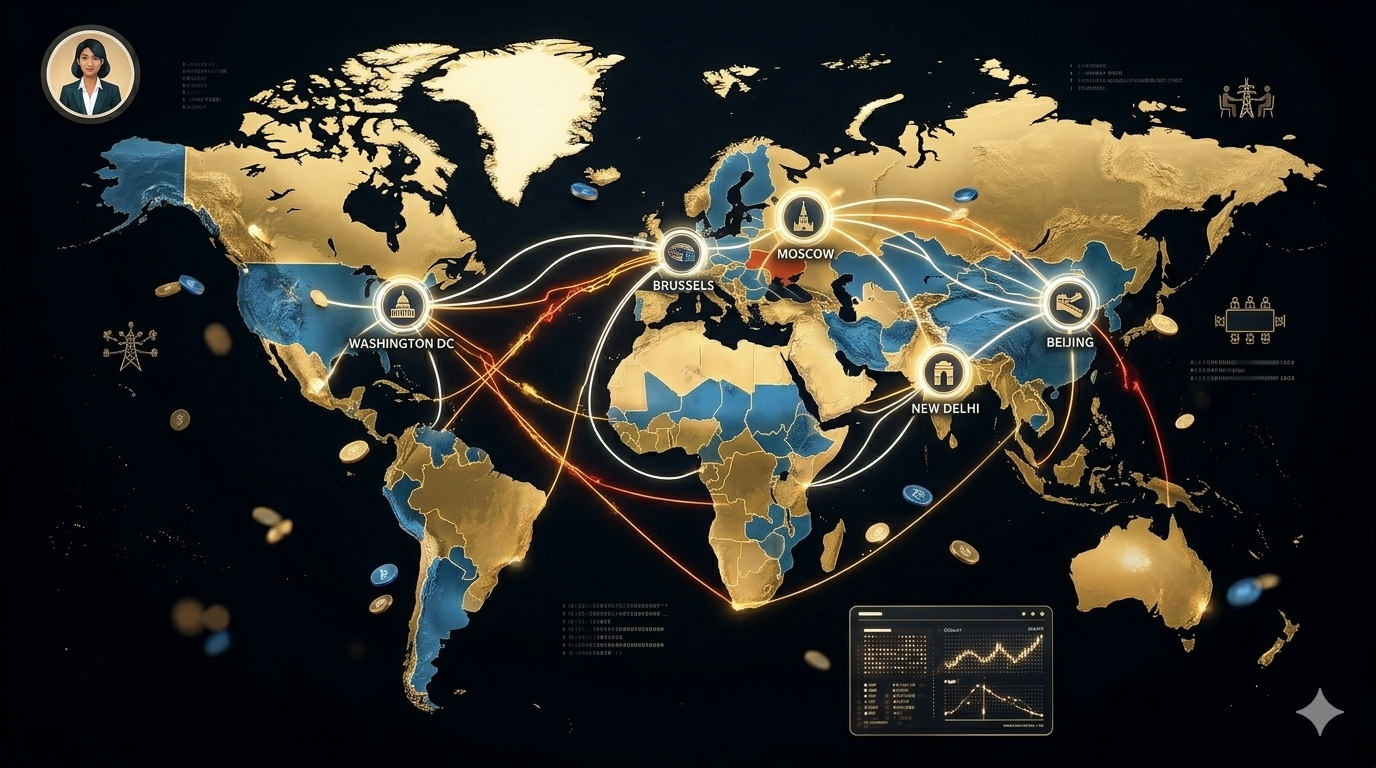
The US-China competition in 2026 is not primarily a military rivalry. It is a technology race, a supply chain contest, a financial system competition, and a battle for global narrative influence all running simultaneously. The US semiconductor export controls that began in 2022 have created two increasingly separate technology ecosystems. China is developing domestic alternatives to Nvidia chips, US cloud platforms, and Western social media. Taiwan remains the world's most consequential geopolitical flashpoint, not because war is imminent but because the global economy's dependence on Taiwan Semiconductor Manufacturing Company's chips means any disruption there would be felt in every country in the world within weeks.
India Has Arrived as a Genuine Global Power
India's emergence as a genuine independent global power in 2026 is the most underappreciated geopolitical development of the decade. India became the world's most populous nation in 2023, passed Germany and Japan to become the fifth-largest economy by nominal GDP, landed a spacecraft near the Moon's south pole, chairs and shapes G20 outcomes, and has built deep strategic relationships with both the US through the Quad and Russia through energy trade, without fully committing to either bloc. India is the most sought-after swing vote in every major global governance forum. This strategic autonomy, which India calls Vasudhaiva Kutumbakam (the world is one family), gives it outsized influence relative to its economic weight.
BRICS Expansion Changes the Global Economic Architecture
BRICS expanded in 2024 to include Saudi Arabia, the UAE, Ethiopia, Iran, and Egypt, and is in active discussion with over 30 additional countries about membership or association. The expanded bloc represents over 40 percent of the world's population and a growing share of global GDP. More significantly, BRICS members are actively developing alternatives to US dollar-denominated trade, including bilateral currency settlement agreements and exploratory frameworks for a BRICS settlement currency. The dollar's status as the world's reserve currency is not threatened overnight, but the direction of travel is clear. According to World Bank data, the dollar's share of global foreign exchange reserves has fallen from 70 percent in 2000 to approximately 58 percent in 2026. Read more at BlogofTime.com.
| Global Power | Strength in 2026 | Key Weakness | Trajectory |
|---|---|---|---|
| United States | AI technology, military, financial system, alliances | Domestic political polarization, debt levels | Declining relative dominance but still leading |
| China | Manufacturing, Belt and Road, population scale | Demographic aging, property crisis, innovation gaps | Growing but facing structural headwinds |
| India | Demographics, strategic autonomy, economic momentum | Infrastructure gaps, manufacturing scale | Rising rapidly, key swing power globally |
| European Union | Regulatory power, green technology, trade scale | Energy vulnerability, defense dependence on US | Stable but seeking greater strategic autonomy |
| Russia | Energy, nuclear deterrent, agricultural exports | Ukraine war costs, sanctions, brain drain | Weakening structurally, still disruptive |