India's first e-TDR platform: what it is and why it matters
Mumbai's real estate regulatory architecture just got a significant upgrade. The Brihanmumbai Municipal Corporation (BMC), in coordination with Maharashtra state authorities, has launched India's first fully digital Transferable Development Rights (TDR) marketplace — a platform that digitises a market worth thousands of crores of rupees that previously operated almost entirely on paper, through intermediaries, with minimal transparency.
What is TDR and why does it exist?
When the government acquires private land for a road, a park, a school, or public infrastructure, the landowner is compensated not just in cash but often through Development Rights — the right to build additional Floor Space Index (FSI) elsewhere in the city. These rights, called TDR certificates, can be used by the recipient or sold to a builder who wants to construct a taller or larger building in approved zones. It is a market mechanism that helps the city grow while compensating displaced landowners fairly.
₹8,000Cr+
Estimated annual TDR market in Mumbai
100%
Process now digital — no paper certificates
First
In India — Mumbai leads digitalisation
48hrs
Processing time (vs weeks in paper system)
Before the e-TDR platform, TDR transactions were opaque, slow, prone to fraud, and dominated by brokers who charged 2–5% for intermediation. Digital transactions cut these costs and timelines dramatically.
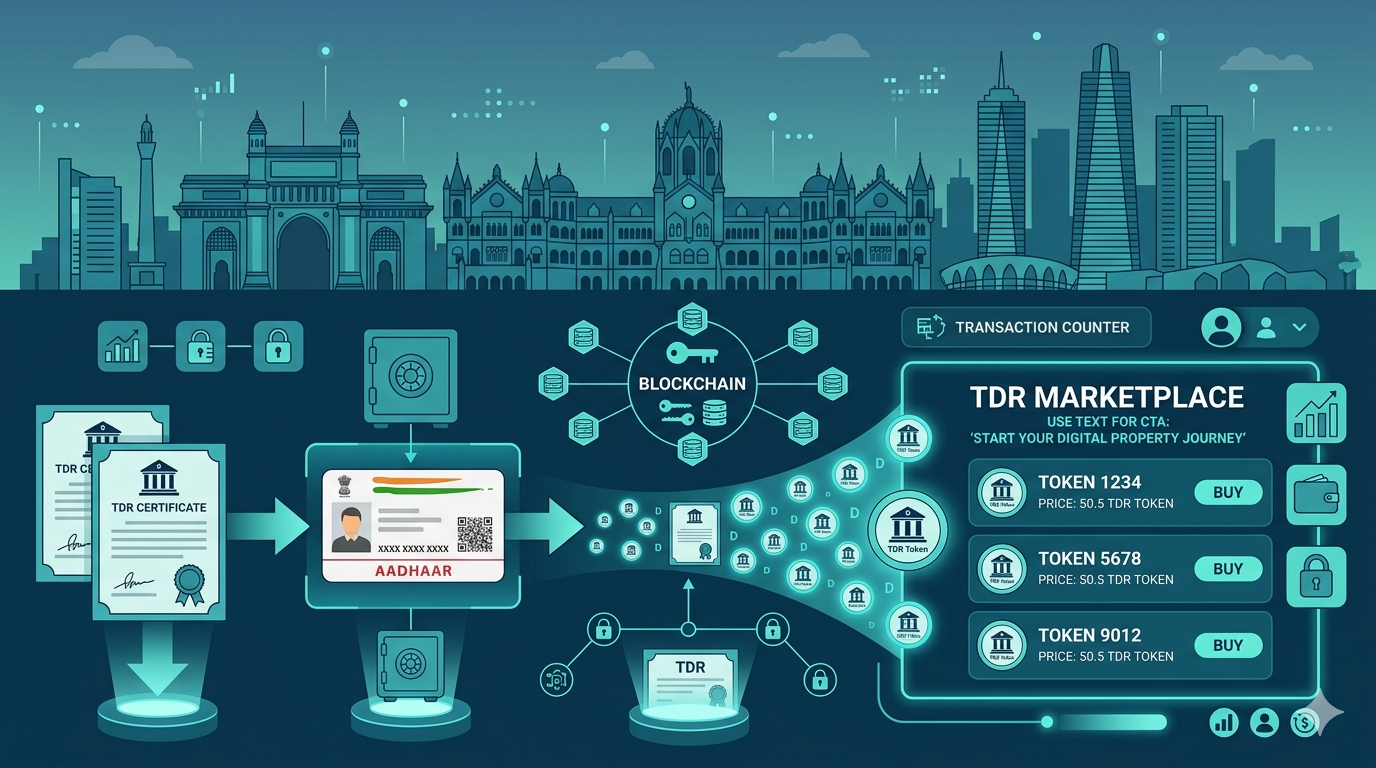
How the e-TDR platform works
| Step |
Action |
Who Does It |
| 1 |
Register on e-TDR portal using Aadhaar/PAN KYC |
Seller or buyer (individual/company) |
| 2 |
Upload TDR certificate (or receive digitally from BMC) |
TDR holder/seller |
| 3 |
List TDR on marketplace with price and zone details |
Seller |
| 4 |
Buyer browses, verifies, and initiates purchase |
Developer/buyer |
| 5 |
Payment through escrow; transfer confirmed digitally |
Platform (BMC oversight) |
| 6 |
Updated TDR certificate issued within 48 hours |
BMC / platform |
Who benefits from this platform?
Small landowners who received TDR after road widening or slum rehabilitation now have a transparent marketplace to sell their rights at fair value. Developers who previously paid broker premiums can now discover TDR pricing directly. The city benefits from faster processing, reduced fraudulent TDR certificates, and a public audit trail. Maharashtra's urban planning authorities gain real-time data on TDR distribution across zones — previously impossible.
What comes next
The Maharashtra government has signalled plans to expand the e-TDR platform to Pune, Nashik, and Nagpur in subsequent phases. There are also discussions about integrating e-TDR with RERA (Real Estate Regulatory Authority) filings and stamp duty automation — creating an end-to-end digital stack for real estate transactions in the state.
The e-TDR platform is a model that every major Indian city should replicate. Chennai, Hyderabad, Delhi, and Bengaluru all have significant TDR markets that remain opaque and intermediary-heavy — ripe for the same transparency revolution.
The e-TDR platform is a quiet but significant leap in how India manages urban development rights. It brings fairness, speed, and transparency to a market that badly needed all three. For more property news, urban policy explainers, and real estate guides for Indian cities, explore
BlogofTime.com.
Frequently Asked Auestions
What is TDR in Mumbai real estate?
TDR (Transferable Development Rights) is a policy tool that gives landowners additional Floor Space Index (FSI) when their land is acquired for public purposes. These rights can be used to build more on another plot or sold to a developer who needs extra FSI in approved areas.
What is the e-TDR platform in Mumbai?
It is India's first digital marketplace for buying, selling, and transferring TDR certificates in Mumbai. Launched by the BMC and Maharashtra government, it replaces the paper-based TDR system with an Aadhaar-authenticated, escrow-backed online platform.
Who can use the Mumbai e-TDR platform?
Any individual landowner who holds valid TDR certificates, as well as property developers and builders looking to purchase TDR for construction projects in Mumbai, can register and transact on the platform using Aadhaar/PAN-based KYC.
How does e-TDR reduce fraud in Mumbai?
The digital platform creates a verified, tamper-proof record of all TDR certificates linked to Aadhaar identity. Previously, paper TDR certificates could be forged or double-sold. The blockchain-anchored ledger prevents double-spending and provides a full audit trail.
Will the e-TDR platform expand to other Indian cities?
Yes. Maharashtra plans to roll it out to Pune, Nashik, and Nagpur in Phase 2. Other state governments including Tamil Nadu and Karnataka are reportedly studying the Mumbai model for potential adoption in their urban centres.