India's role in the global economy
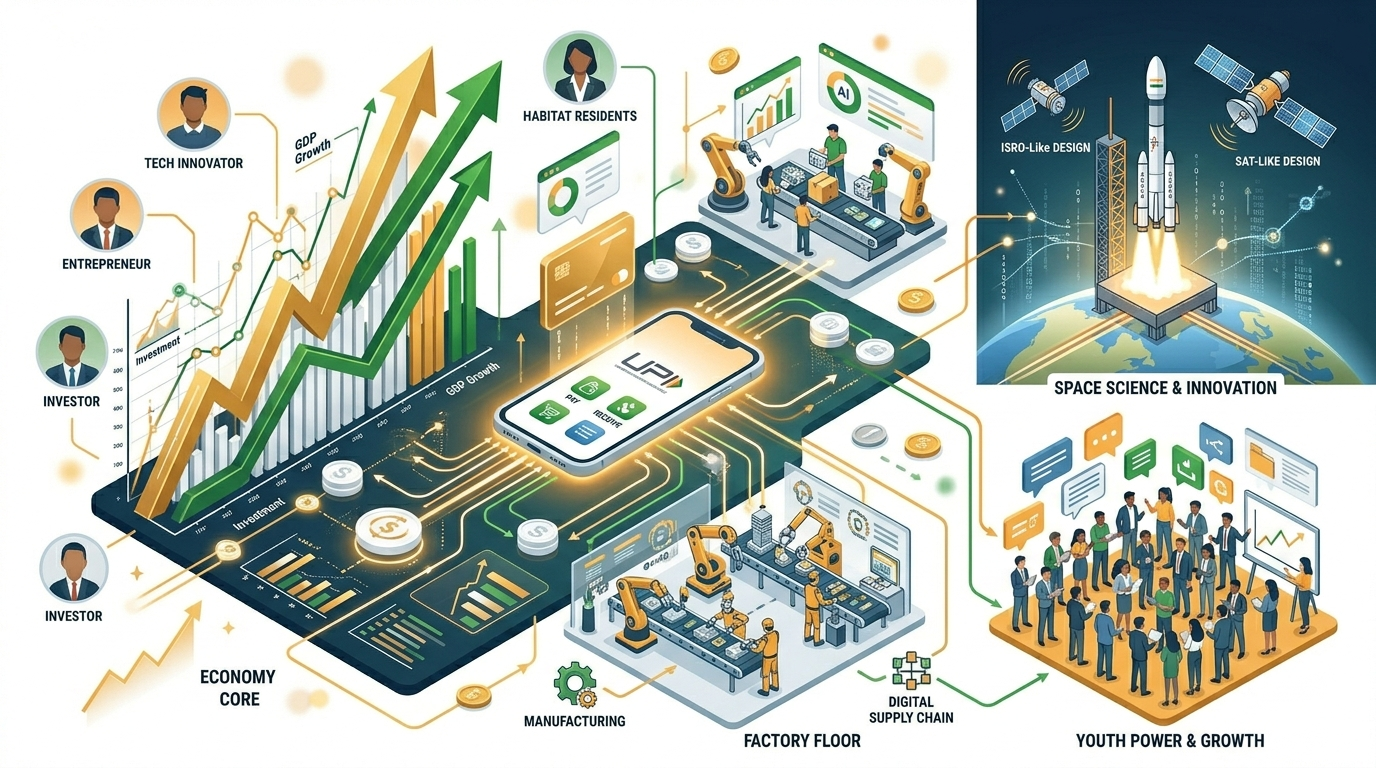
India is no longer just an emerging market — it is an emerging power. With the world's largest population, a booming technology sector, and a government actively courting global manufacturing, India is reshaping trade flows, technology supply chains, and geopolitical alliances in real time.
The numbers behind India's rise
India's GDP crossed $3.7 trillion in 2024, making it the fifth-largest economy globally. At its current growth rate of 6–7% annually, India is projected to overtake Japan and Germany to become the world's third-largest economy by 2027–2030. This is not speculative — it is backed by IMF, World Bank, and Goldman Sachs projections.
India's tech sector drives exports worth over $250 billion annually. Companies like TCS, Infosys, Wipro, and HCL service global corporations across banking, insurance, healthcare, and retail. Indian-origin CEOs now lead companies including Google, Microsoft, Adobe, IBM, and FedEx.
$3.7T
India's GDP (2024) — 5th globally
6–7%
Annual GDP growth rate
$250B+
IT/tech exports annually
#1
World's largest UPI digital payments network
India processes over 10 billion UPI transactions monthly — more than the rest of the world's real-time payment systems combined — making it the global leader in digital payment infrastructure.
India vs other major economies: key comparison
| Economy |
GDP (2024) |
Growth Rate |
Key Strength |
Global Rank |
| United States |
$27.4T |
2.5% |
Finance, tech, defense |
1st |
| China |
$18.5T |
4.6% |
Manufacturing, exports |
2nd |
| Germany |
$4.5T |
0.2% |
Engineering, exports |
3rd |
| Japan |
$4.2T |
0.9% |
Technology, autos |
4th |
| India |
$3.7T |
6.5% |
IT, digital, pharma |
5th |
The China+1 opportunity
As global companies seek to diversify manufacturing away from China, India is the top beneficiary. Apple now makes 14–18% of its iPhones in India through Foxconn and Tata Electronics. Samsung, Tesla, and dozens of semiconductor companies are expanding Indian operations. India's PLI schemes offer production-linked financial incentives across 14 sectors including electronics, pharmaceuticals, and textiles.
Challenges India must overcome
Despite the momentum, India faces significant challenges: infrastructure gaps, regulatory complexity, income inequality, and a need to create 10–12 million new jobs every year for its young population. The rural-urban divide and skill gaps in manufacturing also require sustained policy attention.
India's biggest advantage — and biggest pressure point — is its youth: 600 million people under 25, who need jobs, education, and economic opportunity at a scale no democracy has ever delivered before.
India's rise is one of the defining economic stories of our time — a country of 1.4 billion people rapidly building the infrastructure, industries, and institutions needed to lead the 21st century. Stay updated on global economics, policy, and emerging markets at
BlogofTime.com.
Frequently Asked Questions
Will India become the world's largest economy?
India is projected to become the world's third-largest economy by 2027–2030 and could theoretically challenge for the top spot by mid-century, but surpassing the US or China would require decades of sustained, high-quality growth.
What makes India important to the global economy?
India is critical as a technology services hub, pharmaceutical supplier (producing 20% of global generic drugs), growing consumer market, manufacturing alternative to China, and a democratic partner for Western nations seeking supply chain diversification.
Why is India's digital economy significant?
India's UPI payment system, Aadhaar identity infrastructure, and Jan Dhan banking scheme have brought 500 million people into the formal financial system — a model now being studied and replicated by countries worldwide.
How does India benefit from the China+1 strategy?
As companies diversify manufacturing away from China, India offers a large skilled workforce, improving infrastructure, English proficiency, democratic governance, and government incentives — attracting billions in foreign direct investment.
What are India's biggest economic challenges?
Infrastructure deficits, regulatory complexity, job creation at scale for a young population, agricultural dependence, income inequality, and navigating geopolitics between the US and China remain India's primary economic challenges.