US vs China tech war explained
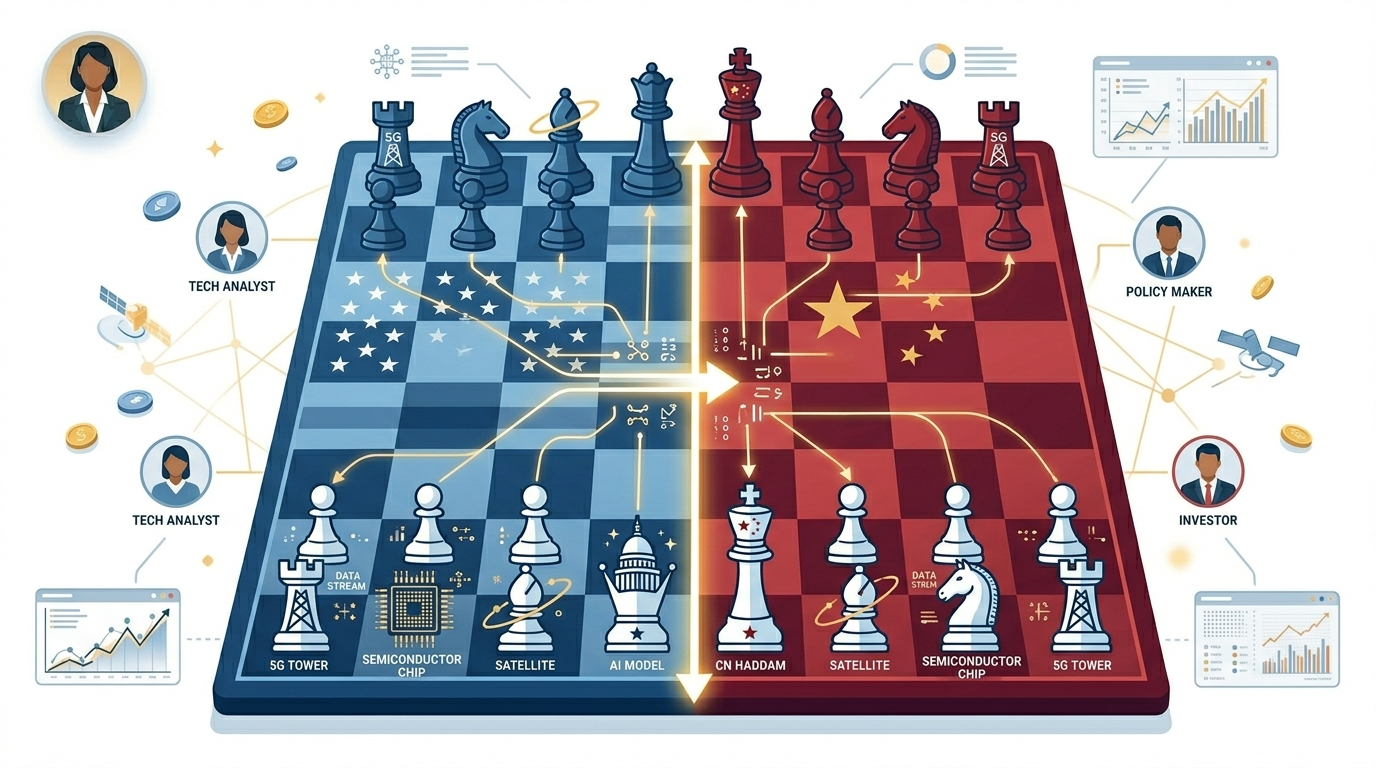
The technology competition between the United States and China is the defining geopolitical conflict of the 2020s. Unlike traditional wars, this one is fought with export controls, research funding, chip manufacturing, and AI development rather than weapons. But the stakes are just as high.
Why semiconductors are the battlefield
Advanced semiconductors — the chips that power AI, smartphones, weapons, and communications — sit at the center of the conflict. The US controls the world's most advanced chip design tools through companies like NVIDIA, Intel, and the software firms Cadence and Synopsys. Taiwan's TSMC manufactures the world's most advanced chips. The US has used export controls to block China from accessing chips below 7nm, critical for AI development.
China's response has been to pour $150 billion into domestic chip manufacturing through its "Big Fund" initiative, with goals of producing advanced chips domestically by 2030. Progress has been slower than Beijing hoped, but it is accelerating.
$150B
China's domestic chip investment fund
90%
Advanced chips made in Taiwan (geopolitical risk)
$600B
Projected global chip market by 2030
Whoever controls advanced semiconductor manufacturing controls the pace of AI development, military technology, and the entire
digital economy — which is why both the US and China treat chip access as a national security issue.
US vs China tech dominance: key battlegrounds
| Technology Area |
US Advantage |
China Advantage |
Who's Winning? |
| Semiconductors |
Design, EDA tools |
Scale, investment |
US (for now) |
| AI / LLMs |
OpenAI, Anthropic, Google |
Baidu, Alibaba, DeepSeek |
US leads, gap closing |
| 5G Infrastructure |
Qualcomm chips |
Huawei networks |
China (globally) |
| Quantum Computing |
IBM, Google |
USTC, Baidu |
Too early to call |
| Electric Vehicles |
Tesla |
BYD, CATL, NIO |
China (globally) |
| Space Technology |
SpaceX, NASA |
CNSA, Long March |
US leads |
AI race intensifies
The AI competition is accelerating. China's DeepSeek shocked the industry in early 2025 with a model that rivaled GPT-4 at a fraction of the training cost — demonstrating that chip restrictions have not stopped Chinese AI progress, they have pushed China to optimize more efficiently. The US maintains a lead in foundational AI research but the gap is narrowing.
The US-China tech war is not about blocking progress — both sides continue to innovate rapidly. It is about who controls the critical infrastructure that will power the next 50 years of the global economy.
The US-China tech war will define the shape of the global economy, military power, and daily technology for the next generation. Staying informed about this rivalry is not optional for anyone navigating a connected world. For more geopolitics, tech analysis, and global trends, head to
BlogofTime.com.
Frequently Asked Questions
Why is the US restricting chip exports to China?
The US argues that advanced chips can enhance China's military AI capabilities and surveillance technology. Export controls on chips like NVIDIA's H100 are designed to slow China's military-AI development, which Washington considers a national security threat.
Can China develop its own advanced chips?
China is working aggressively toward domestic chip production. SMIC has produced 7nm chips using older equipment, but producing 3nm or 2nm chips — which require ASML's EUV machines that are also export-restricted — remains extremely challenging.
Who is winning the US-China tech war?
The US maintains advantages in chip design, AI research, and software. China leads in 5G network deployment and EV manufacturing. The outcome is not decided — it depends heavily on semiconductor independence and AI development over the next decade.
How does the tech war affect consumers worldwide?
It affects global supply chains, product prices, and technology access. Huawei exclusions from Western 5G markets, TikTok bans, and chip shortages are all downstream effects of this geopolitical rivalry that consumers experience directly.
What role does Taiwan play in the tech war?
Taiwan's TSMC produces 90% of the world's most advanced chips, making it the most strategically important piece of global technology infrastructure. Both the US and China understand that control of Taiwan would shift the balance of power in the tech war decisively.